Questions about container handling, vertical loading and cover systems
Find practical answers about choosing a system, improving your loading or unloading process and building a sound business case. The examples below draw on VAKO’s project research and completed customer installations; the outcome for your site depends on your material, equipment and operating conditions.
Find your application
Start with the process you want to improve
VAKO engineers the handling method around the container, material and site. These three routes help you find the most relevant information.
Load bulk into containers
Compare mobile and stationary vertical loading for 20ft and 40ft container flows.
Explore vertical loadingTip and unload containers
Explore controlled discharge into a silo truck or another receiving process.
Explore tipping systemsCover vehicles and loads
Compare cover solutions for different bodies, materials and operating conditions.
View all VAKO systemsVertical loading
Container utilisation, materials and system choice
Does vertical loading increase a container's capacity?
It does not change the container’s physical volume or permitted weight. For suitable bulk materials, loading from above can help use more of the available space. The applicable container, road and shipping limits still determine the maximum load. Read more about vertical container loading.
How much can vertical loading improve container utilisation and loading time?
VAKO’s project research includes examples of 5–15% better container utilisation and 10–20% shorter loading cycles. These are researched outcomes, not a fixed result for every installation. Material behaviour, the previous method and the complete site process determine the achievable improvement. Use the container loading ROI calculator to explore the effect of your own volumes and costs.
How much time and labour can vertical loading save when loading scrap?
At the Danish customer site, the custom 40ft vertical loader recorded 30% more scrap per container, 40% shorter loading time and 50% less labour at the loading point. These figures belong to that project and were measured against its previous loading method. See the full aluminium scrap project for the before-and-after context.
Which VAKO solution fits 20ft or 40ft containers?
The mobile MVL20 is designed around 20ft containers and the mobile MVL40 around 40ft and high-cube containers. A stationary SVL20 can suit a recurring 20ft flow at a fixed point. The right concept also depends on material, loading frequency, site layout and upstream equipment. Compare the MVL20, MVL40 and SVL20.
When should we choose mobile rather than stationary loading?
A mobile system can serve different positions or sites. A stationary system can be integrated more deeply into a recurring flow with fixed feed equipment. VAKO compares the complete process, including container movement, operator tasks and available space, before recommending either concept. Explore the VAKO system range before discussing a site-specific configuration.
Which materials can be loaded vertically?
Applications can include suitable scrap, biomass, wood products, pellets, grain, feed and other loose bulk materials. Density, particle size, moisture, dust, flow behaviour and unloading requirements need to be assessed for each product.
Can a VAKO system connect to an existing line?
Yes. VAKO can engineer the interfaces with conveyors, hoppers, silos, vehicles, controls and the available site structure. The project design must account for the surrounding equipment and the entire loading sequence. The Steinweg project shows how two systems and a conveyor interface were combined.
How are container condition and operator safety addressed?
Container suitability, load limits, locking, support, operating sequence and safe operator positions are part of the design review. The specific safeguards depend on the machine, material and site; controlled loading can reduce manual intervention around the loading point.
Compare equipment
Explore the VAKO vertical loader range
These product pages explain the equipment behind the answers above. VAKO adapts the final configuration to the customer’s process.
SVL20
A stationary 20ft loading point for an integrated site process.
Explore the SVL20Unloading and transfer
Tipping stations and integrated bulk handling
What is the difference between a vertical loader and a tipping station?
A vertical loader positions a container for loading material into it. A tipping station positions and tips a filled container to discharge its contents into a receiving vehicle, hopper or conveyor. The receiving process determines the required discharge height and controls. See VAKO’s container tipping systems for the unloading application.
Can one elevated station handle different container lengths?
The VAKO installation at Maasvlakte handles 20ft, 30ft and 40ft containers above silo trucks at one unloading point. Its hot-dip galvanised construction supports outdoor use, while sensors, the control system and weighbridge help coordinate the unloading process. See the Maasvlakte project.
How quickly can a tipping station unload a container into a silo truck?
For that customer application, the previous unloading cycle of 60–90 minutes became 20–30 minutes. Staffing changed from two to three people to one operator, and product loss fell from up to 10% to less than 1%. These figures describe that installation, not a standard specification for every tipping station. The project page sets out the complete installation and comparison.
Can a container tipping station handle food products such as coffee beans?
Yes. For Steinweg, VAKO supplied an SVL20 and a separate tipping station as one container-transfer workflow, including a food-grade finished hopper and conveyor interface. The project recorded a reduction in container turnaround from two to three hours to 20–30 minutes, with one operator managing the transfer. Read the Steinweg project story.
Completed projects
See how the answers work in practice
These outcomes were recorded for the named customer projects. Open the full project stories for the challenge, engineered solution and before-and-after context.
 Scrap processing
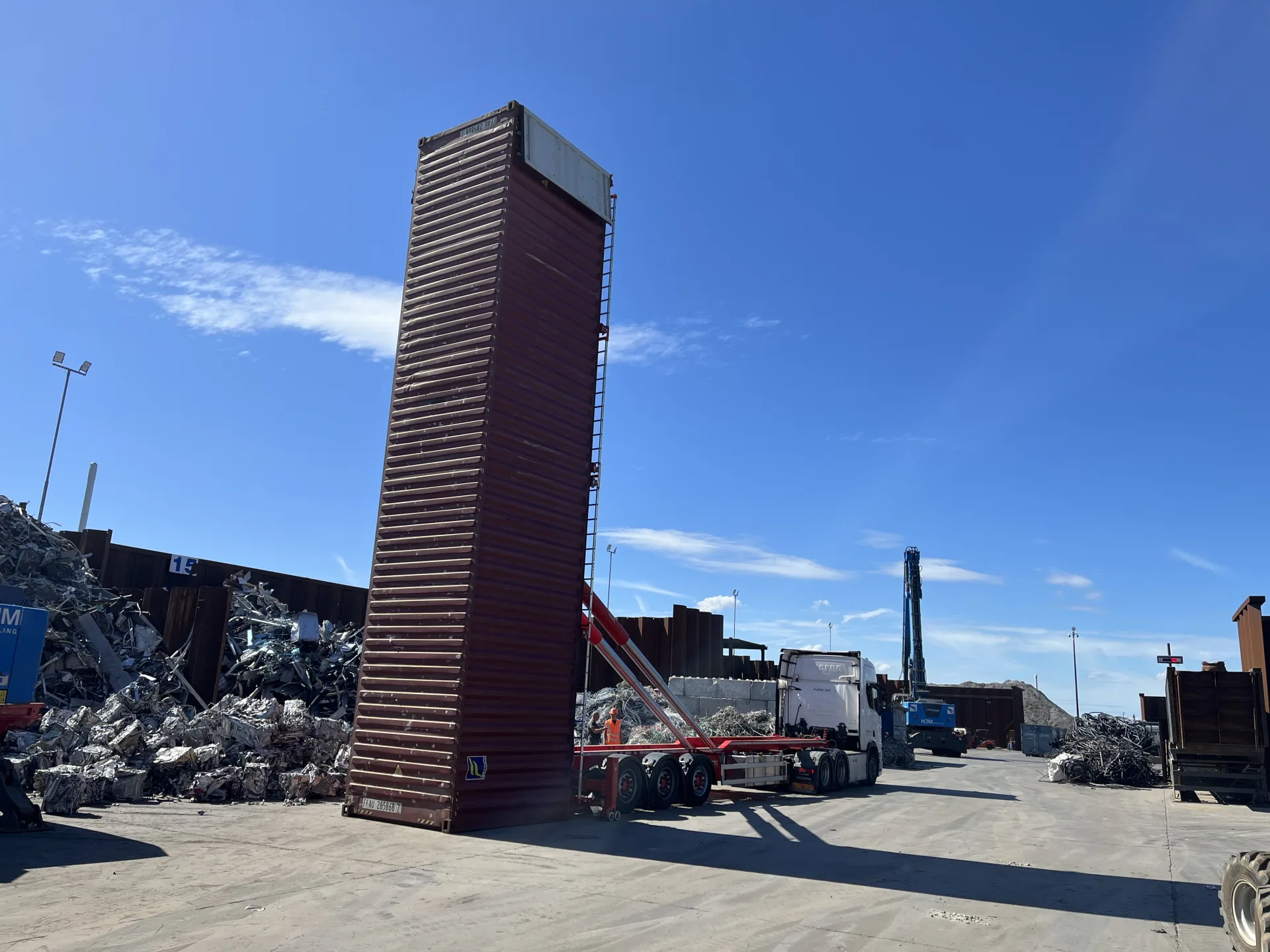
 40ft aluminium scrap loading
A custom vertical loader in Denmark recorded 30% more scrap per container and 40% shorter loading time.
View the scrap project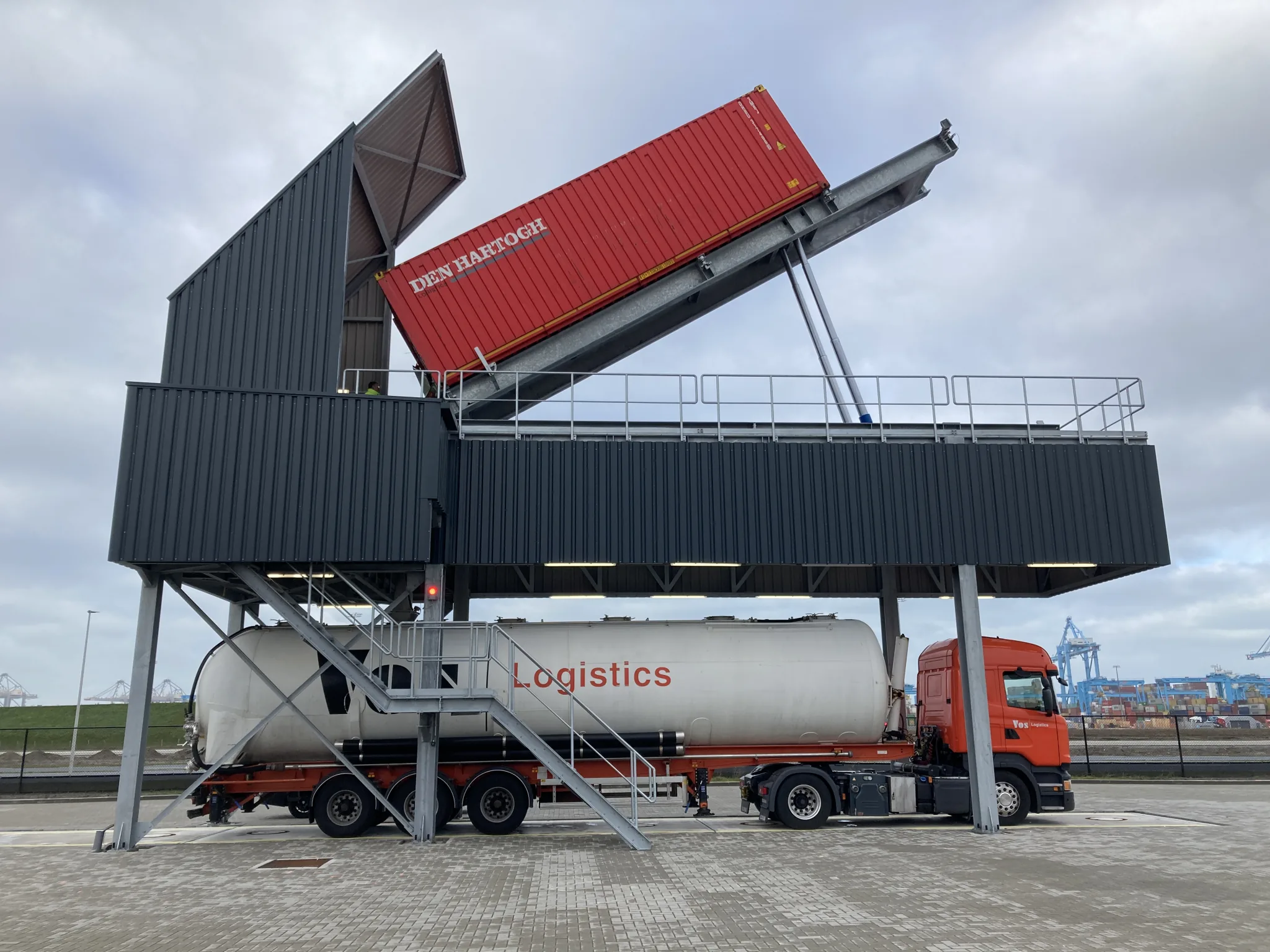 Bulk logistics
 Elevated unloading at Maasvlakte
One tipping station handles 20ft, 30ft and 40ft containers above a silo truck.
View the tipping project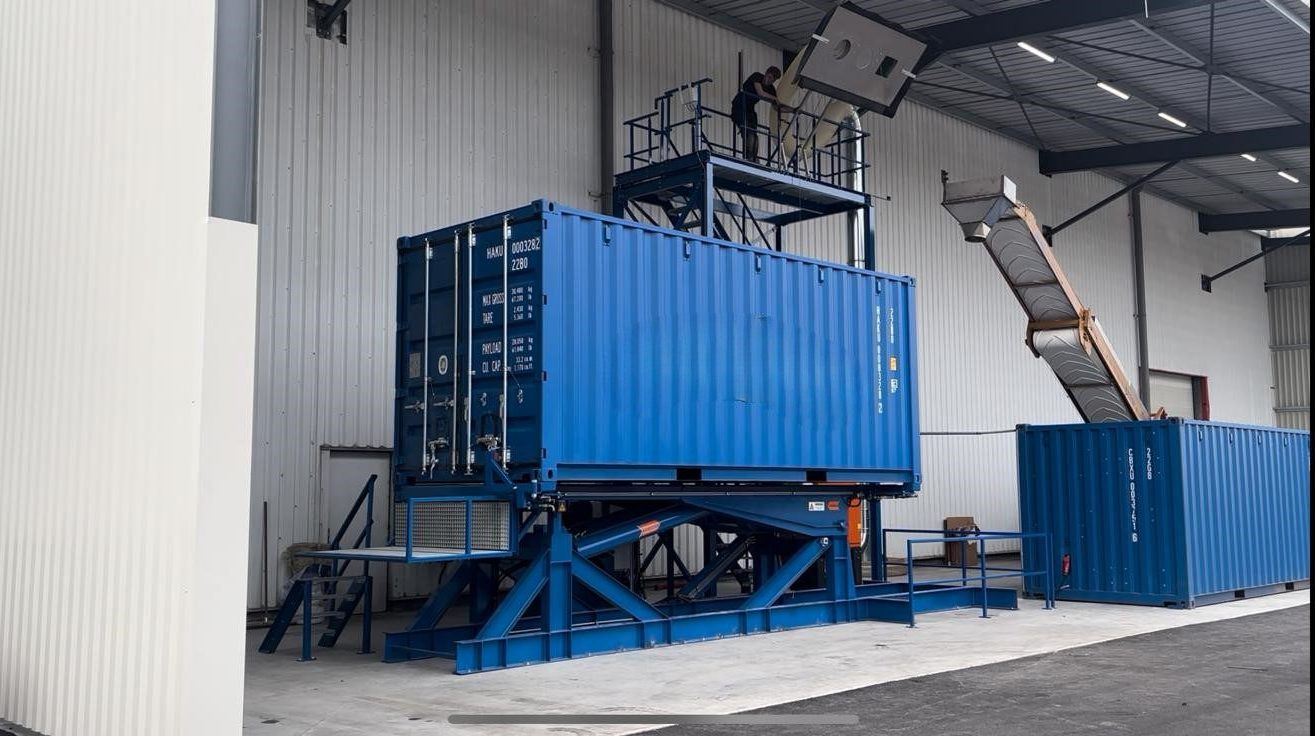 Product care
 Coffee-bean transfer for Steinweg
An SVL20 and tipping station reduced container turnaround from hours to minutes.
View the Steinweg project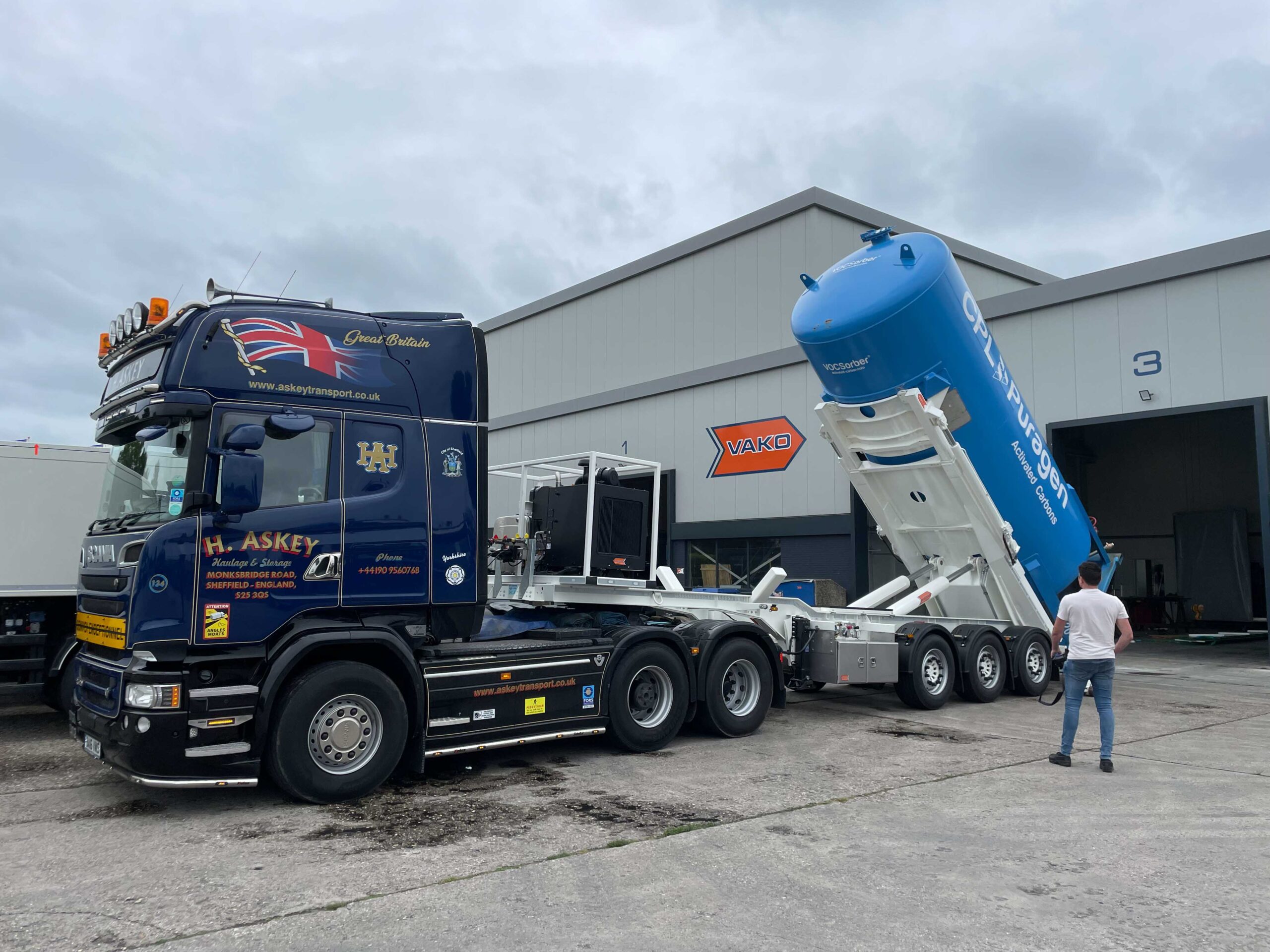 Custom engineering
 MSF01 filter-positioning trailer
A custom trailer transports carbon filters horizontally and raises them upright on site.
View the MSF01 projectCover systems
Choosing and using a VAKO cover solution
Which VAKO cover systems are available?
The range includes the lightweight CS-L, the aluminium-panel CS-MK, the folding CS-VK and the one-sided CS-OS. Body type, load profile, required side access, operating frequency and durability needs determine the best fit. Compare the CS-L, CS-MK, CS-VK and CS-OS.
How can a cover system save time and improve safety?
Hydraulic operation can reduce manual covering steps and the need for a driver to climb onto a body or trailer. The benefit depends on how often the vehicle is loaded and covered and on the current working method.
Can a VAKO cover system be fitted to an existing vehicle?
A retrofit may be possible when the body or trailer is suitable. VAKO checks dimensions, mounting points, load profile, available space and the condition of the existing vehicle before proposing a system. Send VAKO your vehicle details for an initial review.
When should we choose aluminium panels rather than net or tarpaulin?
Aluminium panels may suit intensive use and a need for a robust cover. Net or tarpaulin can be more appropriate when lower system weight or a different cargo profile matters. The right choice depends on the material, body and daily duty cycle.
Can a cover system reduce product loss during transport?
Appropriate coverage can help contain the load and protect it from weather. The effect depends on the material, vehicle, cover design and route; VAKO selects the configuration around those conditions.
Business case
ROI, staffing and operational efficiency
How should we calculate the return on a VAKO system?
Compare the current and proposed process using annual volume, payload per container, complete cycle time, staffing, equipment use, transport movements, product loss and relevant site costs. Include the investment and operating costs of the proposed system. Start with the container loading ROI calculator and then review the assumptions with VAKO.
Can a small payload improvement justify an investment?
VAKO’s project research shows that even a 5% payload improvement can matter across a high annual container volume. Whether it pays back for your operation depends on shipment count, material value, freight cost and the applicable weight limits. The 40ft aluminium scrap project shows a recorded customer result.
Do shorter loading cycles increase site capacity?
They can when loading is a real constraint in the complete process. VAKO’s project research includes examples of 5–15 minutes saved per loading cycle; the annual value depends on daily volume, staffing, upstream supply and truck availability.
Can fewer container movements reduce emissions?
If a compliant increase in payload means fewer journeys for the same annual tonnage, transport-related emissions may also fall. Calculate the effect using your actual routes, vehicles, payloads and number of avoided trips.
What information should we send VAKO for an initial assessment?
Share the material and its density, container size, current payload, annual volume, complete cycle time, number of operators, site layout, feed or receiving equipment and the main problem you want to solve. VAKO’s engineers can then review the relevant loading or unloading concept. Share your application with VAKO.
Turn your handling question into a workable project
Tell VAKO what you handle, which container or vehicle you use and where time, labour or capacity is being lost. Our engineering team can assess the complete process and discuss a suitable solution for your site.