Case Study · Elevated Container Tipping Station · Farming, Transportation & Logistics
Unload bulk containers up to 70% faster while reducing labor by 50–60%.
This case study shows how VAKO’s Elevated Container Tipping Station helps agricultural logistics operations unload containers directly into silo trucks faster, cleaner, and with fewer handling steps. How much time, product value, and labor are you losing in your bulk unloading process? Get the full breakdown and read it here.
Traditional unloading often depends on ground-level tipping and secondary conveyor systems, increasing cycle time, contamination risk, labor, and maintenance costs.
faster unloading
labor reduction
months typical ROI
What you’ll discover
A practical breakdown of how elevated tipping improves bulk container unloading into silo trucks.
Why multi-stage unloading slows down agricultural bulk logistics.
How elevated, gravity-assisted discharge removes intermediate handling steps.
Faster unloading, lower labor, reduced contamination risk, and stronger ROI.
Relevant VAKO sectors
Why traditional bulk unloading quietly reduces profitability
In agricultural logistics, profitability depends on speed, product quality, and low handling loss. But when bulk goods are discharged at ground level and moved again by conveyors, every extra step adds friction, risk, and cost.
What changes after elevated tipping?
Cycle time
Labor requirement
Payload loss
Maintenance cost
Continue with the full case study
Below, you’ll find the complete breakdown: market context, operational problem, regulatory pressure, the engineering solution, measurable outcomes, ROI logic, and final recommendations.
Full Case Study
VAKO Transport Systems B.V., a leader in engineered bulk handling solutions, presents a transformative approach to bulk handling – in this case – agricultural logistics with its Elevated Container Tipping Station. This case study details how VAKO’s innovative technology directly addresses the critical inefficiencies in unloading bulk goods into silo trucks, a core process within the agricultural logistics and silage sector.
By replacing multi-stage, ground-level operations with a single-step, gravity-assisted discharge system, VAKO delivers unprecedented gains in operational speed, product integrity, and site safety. The solution is engineered for loads up to 40 tonnes, offering a mobile, durable, and high-clearance alternative that outperforms traditional fixed infrastructure.
We’ve designed this system together with TBMA which was are partner at that time. The result is a quantifiable competitive advantage, with typical return on investment achieved within 18 to 24 months through dramatic reductions in cycle time, labor, and maintenance costs, fundamentally elevating the profitability and reliability of agricultural bulk supply chains.
This document is created to provide valuable insight and is targeted towards Site Managers, Plant Managers, Operations Managers, General Managers & Managing Directors.
Elevated Container Tipping Station for Agricultural Bulk & Silo Truck Logistics
Executive Summary
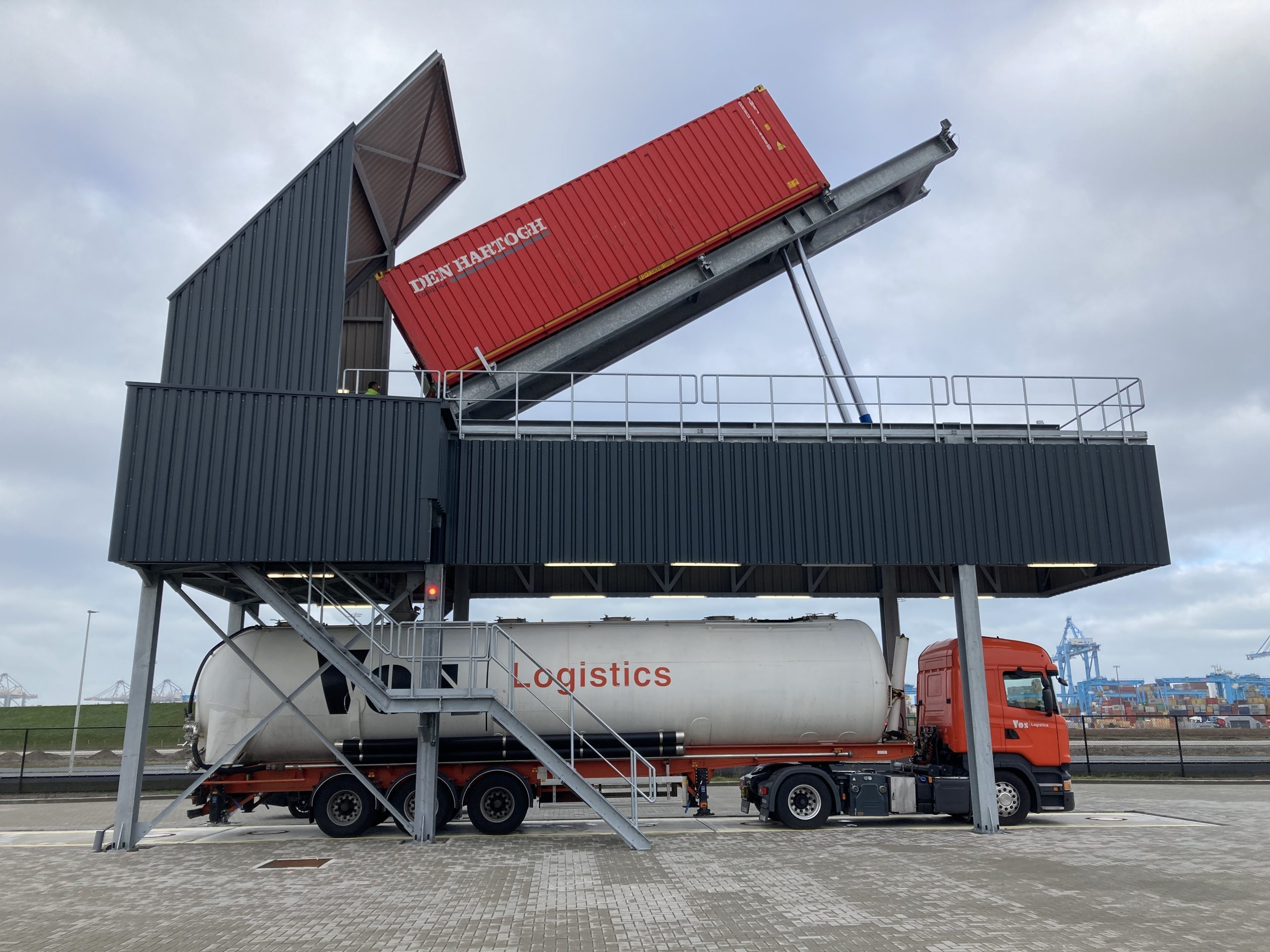
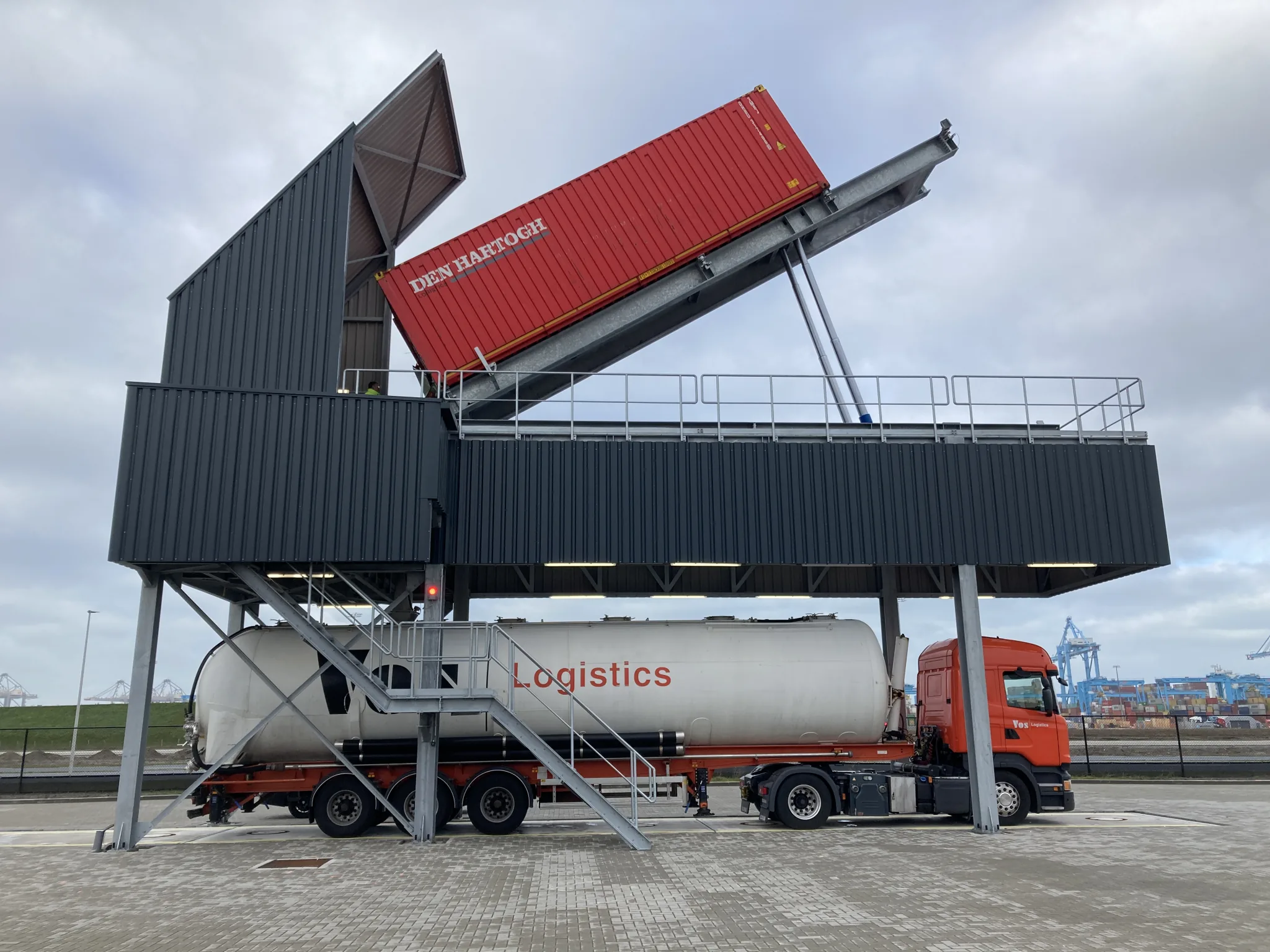
The VAKO Elevated Container Tipping Station is engineered to lift 20′ or 40′ ISO containers to an optimal discharge angle, allowing material to flow directly into silo trucks by gravity alone. This direct-to-silo process removes the need for intermediate conveyors and reduces contamination, product loss, labor, and maintenance.
The system offers measurable gains across every critical performance dimension: shorter cycle times, lower labor requirements, reduced payload loss, fewer maintenance-intensive components, and a cleaner transfer process. For high-volume operations, typical return on investment can be achieved within 18 to 24 months.
Market Context & Client Overview: Agricultural Bulk & Silage Logistics
The handling of grains, feed, fertilizers, and silage demands logistics that are not only efficient but also preserve the quality and purity of the product. Contamination, moisture exposure, and degradation during transfer directly impact the economic value of the payload and the operational margins of ports, cooperatives, and large-scale farms.
The market requires solutions that can handle increasing volumes while adapting to diverse site layouts and seasonal peaks, all within stringent environmental and safety regulations. This context creates a need for technology that streamlines the critical interface between shipping containers and transport vehicles.
Problem Statement
Inefficiencies of Traditional Unloading
Traditional methods for unloading bulk containers into silo trucks are plagued by systemic bottlenecks and hidden costs. The standard process involves a ground-level container tipper, which discharges material onto the ground or into a receiving hopper. From there, secondary conveyor systems—often screw or belt conveyors—are required to lift the material into the waiting silo truck. This multi-stage approach introduces significant operational friction.
Firstly, cycle times are extended by 2 to 3 times due to the sequential handling and repositioning of equipment. Each transfer point is a potential source of spillage and product loss. Secondly, the exposure of material during ground-level tipping and subsequent conveyance creates high risks of contamination from dust, debris, and moisture, potentially degrading 5% to 10% of sensitive payloads like feed grains.
Thirdly, the capital expenditure is substantial, requiring investment not only in the tipper but also in the fixed or mobile conveyor infrastructure. Finally, the maintenance burden is compounded by having multiple mechanical systems exposed to abrasive dust and harsh weather, leading to frequent downtime and high annual repair costs that erode profitability.
European and international compliance increasingly favors cleaner, safer, closed-loop bulk transfer systems.
In the past five years, the European agricultural and silage transport sector has faced an unprecedented tightening of regulatory oversight. Governments across the EU, driven by the Green Deal strategies, have implemented rigorous quality control measures aimed at minimizing product loss and environmental contamination. Companies failing to meet these standards are increasingly subject to heavy fines and operational suspensions.
- Stricter Sanitary Requirements: Inspections now focus heavily on the “closed-loop” integrity of the supply chain. Traditional unloading methods that expose silage or grain to the open air are being flagged as contamination risks, leading to rejected shipments and significant financial penalties.
- Environmental Fines: Spillage during the transfer from containers to silo trucks has become a major target for environmental agencies. In jurisdictions like Germany and the Netherlands, even minor bulk leaks onto site grounds can trigger soil remediation orders and substantial administrative fines.
- Safety Compliance: The European Agency for Safety and Health at Work (EU-OSHA) has stepped up audits on manual handling and machinery-personnel proximity. Systems that rely on manual intervention at height are seeing insurance premiums skyrocket or being prohibited entirely.
By transitioning to VAKO’s Elevated Tipping Station, companies effectively de-risk their operations against these shifting legal frameworks. Our system provides a contained, gravity-assisted discharge that satisfies the most stringent European quality and safety audits.
The Solution: Elevated Container Tipping Station
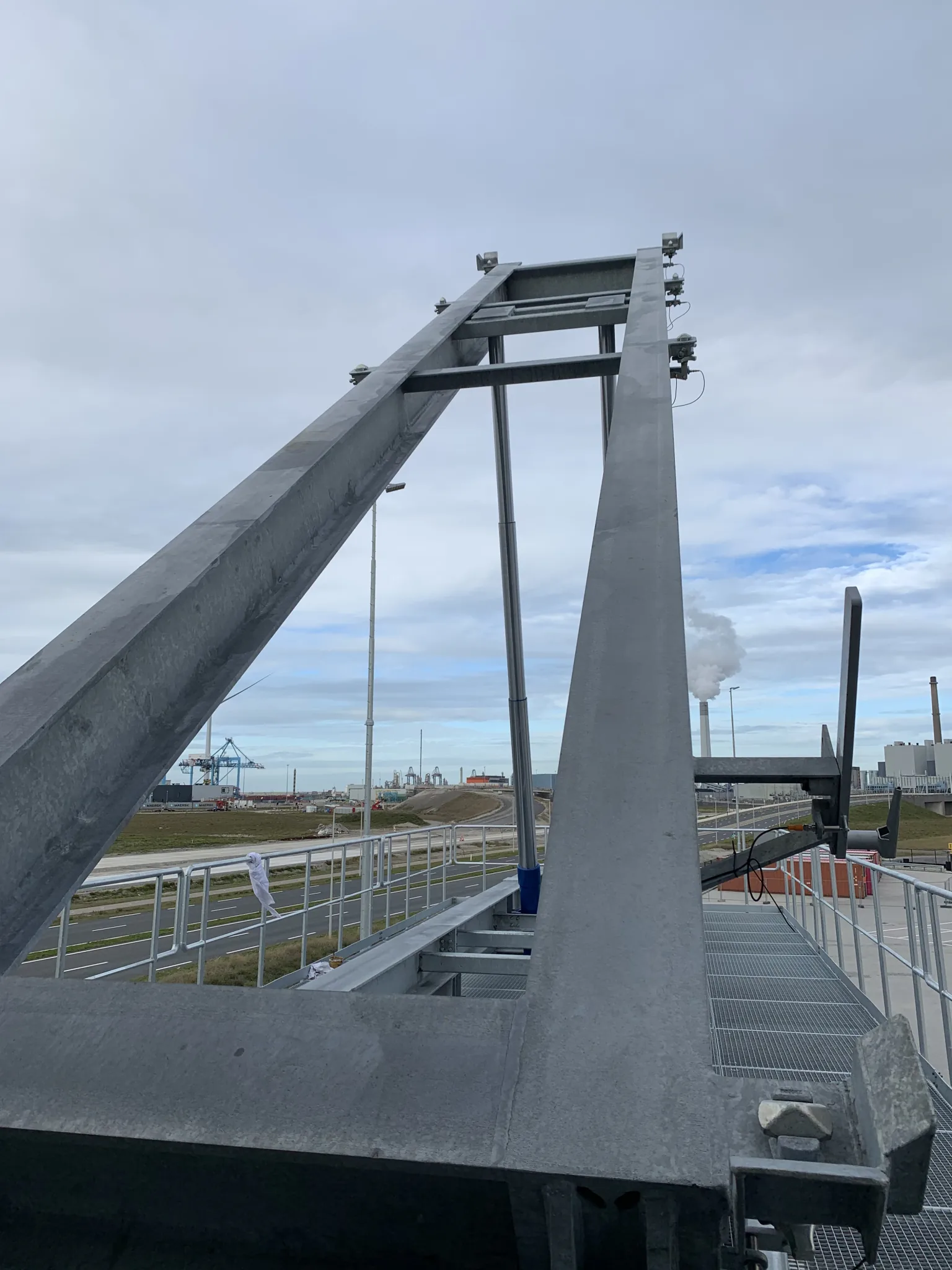
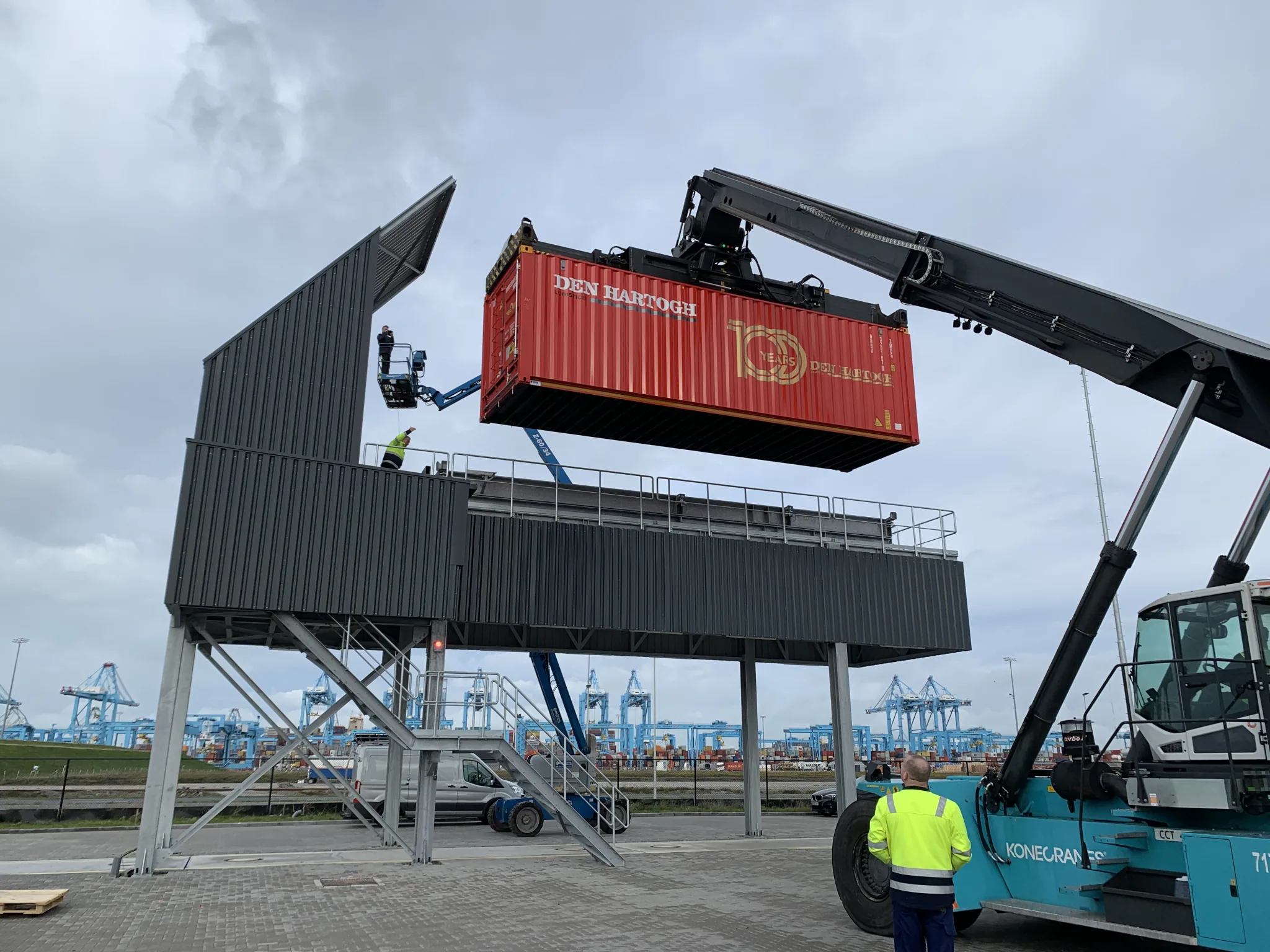
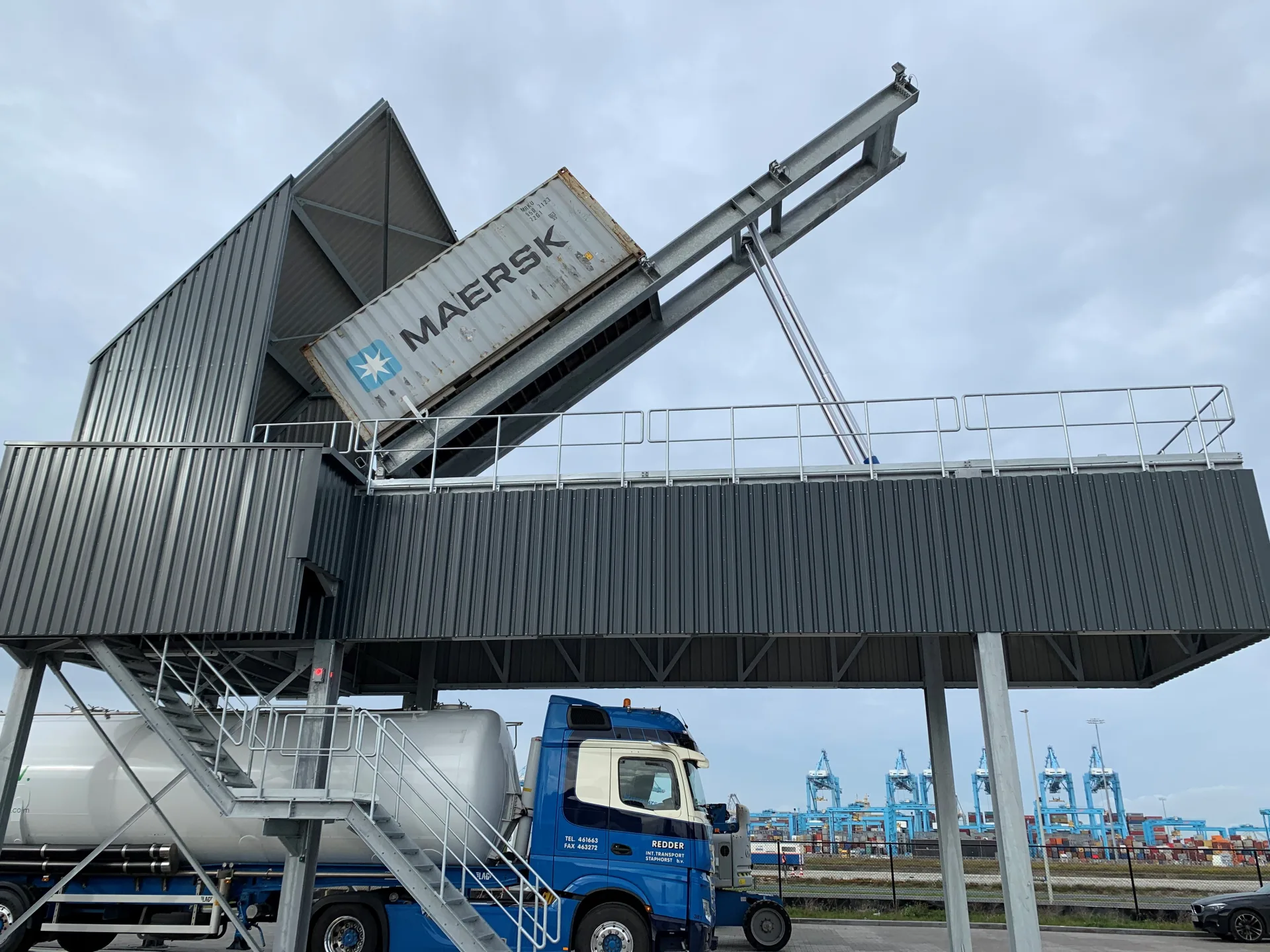
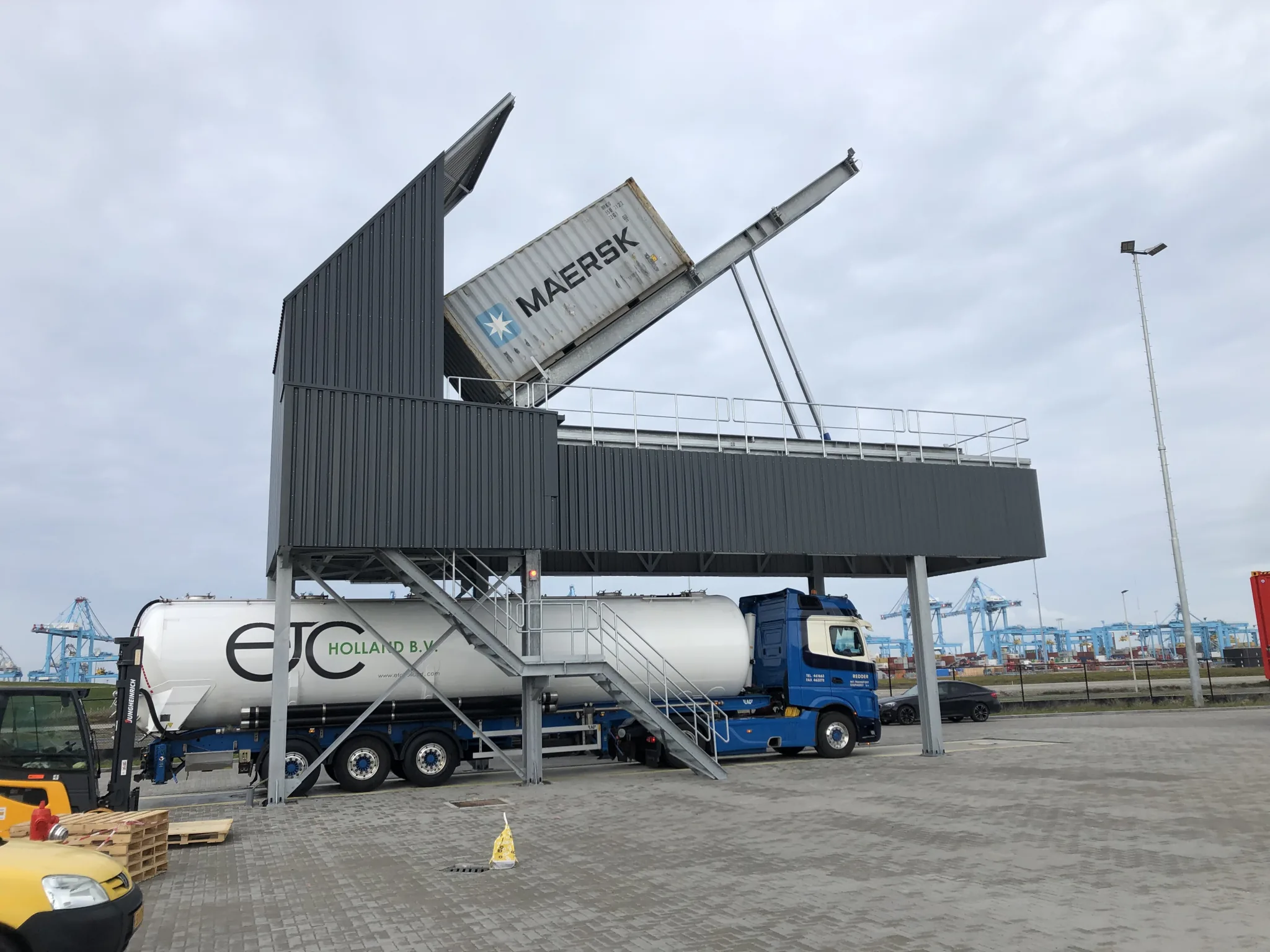
The VAKO solution is an engineering paradigm shift: a mobile Elevated Container Tipping Station. The system employs high-precision hydraulic cylinders to lift standard 20′ or 40′ ISO containers to an optimal discharge angle. This elevated position provides the necessary height and clearance to enable material to flow directly from the container into the silo truck’s intake hatch via gravity alone.
This direct-to-silo process eliminates all intermediate conveyor systems. The high-clearance design ensures the container door clears the silo truck body, allowing for a clean, enclosed transfer. The result is a continuous operation that dramatically accelerates unloading, virtually eliminates contamination risk, and requires minimal manual intervention, transforming a complex logistical chore into a streamlined, efficient process.
Solution Overview
Competitive Landscape: Why VAKO Outperforms
Unlike fixed, in-ground tippers, VAKO’s chassis-mounted station can be relocated in hours. This provides operational flexibility for multi-site use, seasonal demands, or rental fleets, avoiding the massive capital lock-in and site commitment of competitors’ stationary solutions.
VAKO’s elevated design is not merely a tipper on stilts. It is a purpose-built system ensuring sufficient height for direct discharge into modern high-sided silo trucks, a capability where many low-clearance competitors fail.
Key Metrics & Outcomes
The operational superiority of the VAKO Elevated Tipping Station is quantifiable across every critical performance dimension. The following table provides a direct, data-driven comparison between traditional unloading methods and the VAKO solution, highlighting the transformative impact on logistics efficiency and cost control.
Quantitative Performance Improvements
Cycle Time (Per Container)
Labor Requirement
Volume Utilization / Payload Loss
Maintenance Frequency & Cost
Contamination Risk
These metrics are supported by industry benchmarks. For instance, VAKO’s documented case studies show a significant 15% to 35% faster loading speed compared to standard hydraulic tippers, with the potential for up to 45% improvements in optimized silage operations, aligning with and exceeding these competitive industry benchmarks.
Qualitative and Strategic Benefits
Beyond the quantitative data, the Elevated Tipping Station offers profound strategic advantages:
- Enhanced Safety: Remote-controlled tipping keeps personnel entirely out of the “danger zone,” eliminating the risk of injury from falling bulk material or vehicle movement.
- Brand Integrity: Delivering uncontaminated, high-quality silage to partners strengthens your position as a reliable international logistics leader.
- Operational Flexibility: Our designs accommodate 20 ft, 30 ft, and 40 ft containers, allowing you to pivot your logistics strategy without needing new equipment.
Strategic Implications & ROI Analysis
Example of an Industry Standard Financial Analysis
The financial rationale for investing in a VAKO Elevated Tipping Station is compelling and multi-faceted. Beyond the direct labor and time savings, the solution drives value through enhanced asset utilization, reduced product shrinkage, and lower total cost of ownership. The high-clearance, galvanized design ensures durability, minimizing unplanned downtime and extending the asset’s productive life well beyond that of conventional equipment.
Over a 5-year horizon, the cumulative operational savings and margin uplift from increased throughput can deliver a total return on investment exceeding 300%, transforming a capital expenditure into a powerful profit center.
Final Assessment and Recommendations
VAKO Transport Systems B.V. does not just sell machinery; we provide engineered responses to complex logistical challenges. Our commitment to precision and customization has led our company growth for decades. We understand that no two agricultural sites are identical.
Therefore, every Tipping Station we produce is a result of skilled engineers collaborating with our client and our operational team. We specialize in adjusting hydraulic lift speeds, structural heights, and material-specific discharge chutes to ensure that your specific bulk — be it silage, or in grain — flows with absolute efficiency.
Recommendation: For facilities processing more than 10 containers per day, the return on investment (ROI) for an elevated station is typically achieved within 14–18 months through labor and maintenance savings alone. We recommend a site-specific analysis to determine the optimal gantry height and stabilization requirements for your current fleet.
Feel free to talk with us, whether it’s our sales department or one of our engineers.
See how much time and product value you’re currently losing
Many bulk logistics operations underestimate the financial impact of slow unloading, spillage, contamination risk, and conveyor maintenance. Request a quick analysis based on your operation.
- Estimated unloading cycle time improvement
- Indicative product-loss and contamination-risk assessment
- ROI indication for switching to elevated tipping
Our engineering team reviews each request manually — expect a response within 24 hours.
Prefer direct contact? Call us at +31 (0) 71 – 341 07 05
Our opening hours: Monday till Friday 08:00 – 17:30 office hours.