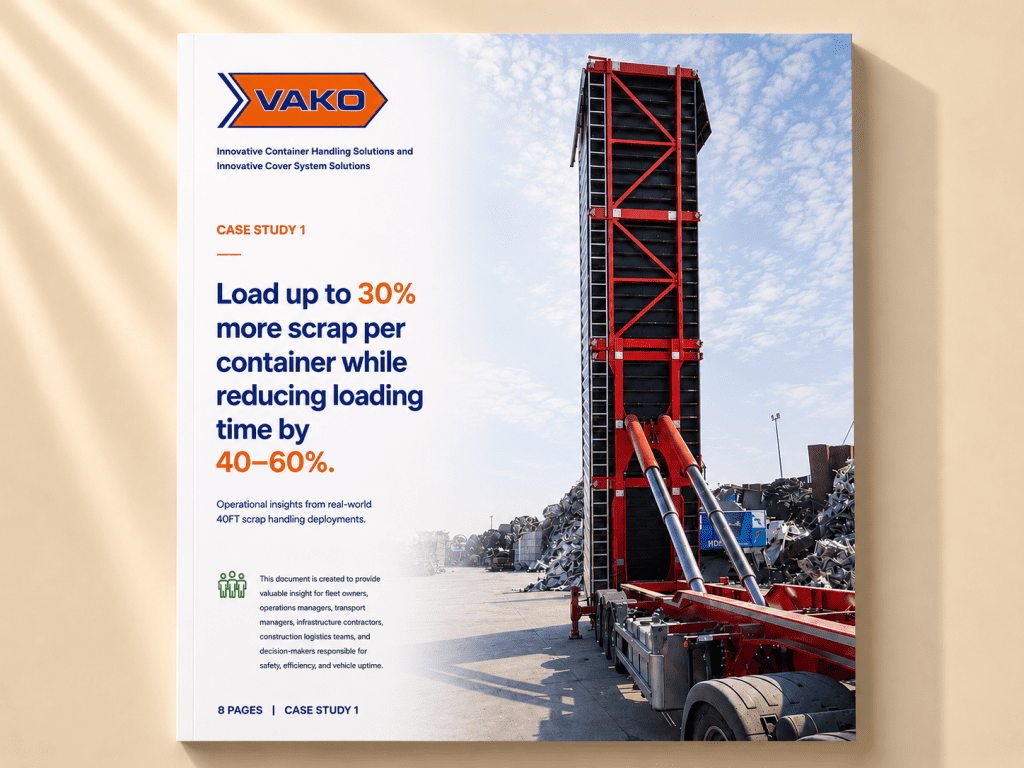
Case Study · 40ft Scrap Loader · Environmental Services, Renewables, Mining & Metals
Load up to 30% more scrap per container while reducing loading time by 40–60%.
This case study shows how VAKO’s 40ft Vertical Loader helps scrap operations load containers faster, denser, and with less damage — by changing the loading method itself. How much payload and time are you losing in your container loading process? Get the full breakdown and read it here.
Traditional horizontal loading often leaves air pockets, damages container sidewalls, and limits usable payload per shipment.
more payload potential
faster loading
less labor
What you’ll discover
A practical breakdown of how vertical loading improves scrap container performance.
Why containers become volume-limited before weight-limited.
How gravity-assisted vertical loading changes container filling behavior.
Faster loading, higher payload, lower labor, and reduced container damage.
Relevant VAKO sectors
Why traditional scrap loading quietly reduces profitability
In scrap export operations, profitability is measured in cost per ton. But when material is pushed horizontally into a 40ft container, the container often looks full before it is truly optimized.
What changes after vertical loading?
Loading cycle time
Volume utilization
Payload per container
Labor requirement
Continue with the full case study
Below, you’ll find the complete breakdown: the original problem, the engineering concept, implementation logic, measurable outcomes, and final recommendations.
Full Case Study
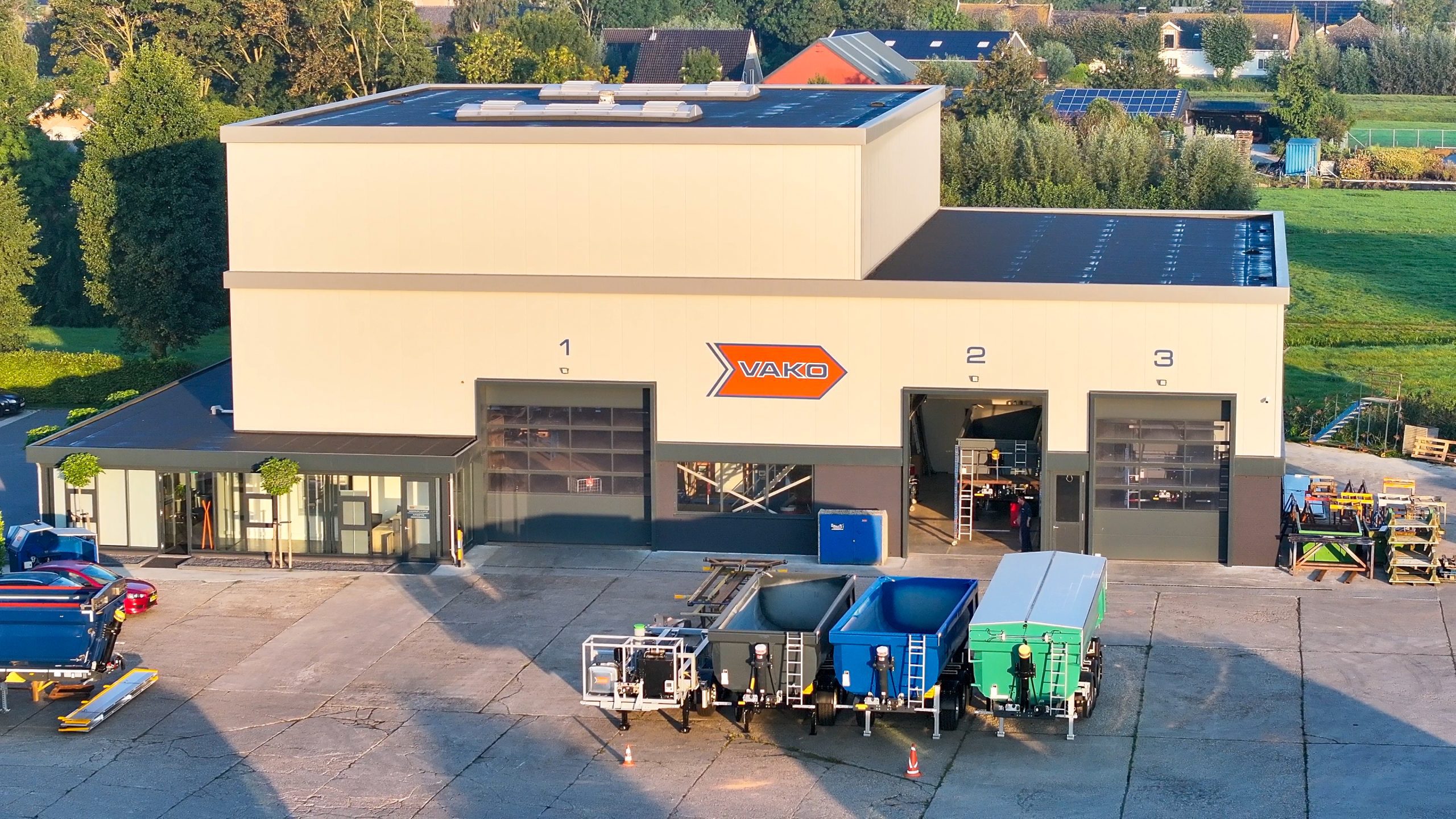
VAKO Transport Systems B.V. is a container handling premier engineering firm specializing in innovative container handling and transport systems. With deep expertise in hydraulic engineering and logistical optimization, VAKO Transport Systems B.V. provides business to business global solutions across bulk transport, scrap processing, port operations, and specialized logistics. The company’s philosophy centers on developing robust, custom-engineered equipment that solves specific material handling challenges in various industries on global level: from Denmark to Australia, and from Canada to The Emirates.
This case study examines the deployment of the 40ft Vertical Loader for Aluminium Scrap Container Loading, a purpose-engineered solution for high-volume scrap metal processing facilities. The system directly addresses the critical industry challenge of efficiently and safely loading aluminium scrap into 40-foot ISO shipping containers for export. By transitioning from traditional, labor-intensive horizontal loading methods to a gravity-assisted vertical loading process, operators achieve significant operational and financial benefits.
This document is created to provide valuable insight and is targeted towards Plant Managers, Operations Managers, Operations Directors, Managing Directors, or Head of Operations.
40ft Vertical Loader for Aluminium Scrap Container Loading
Executive Summary
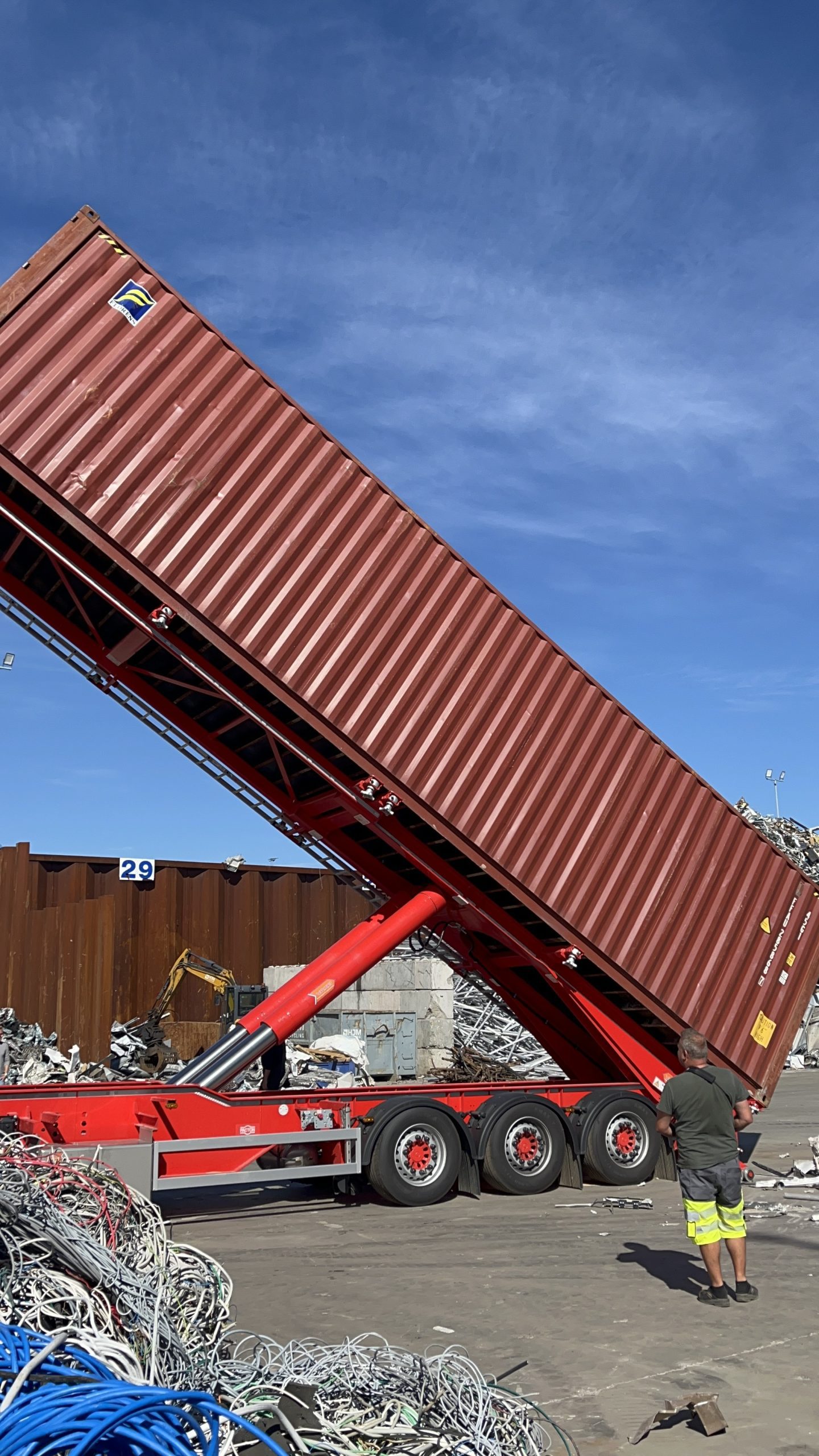
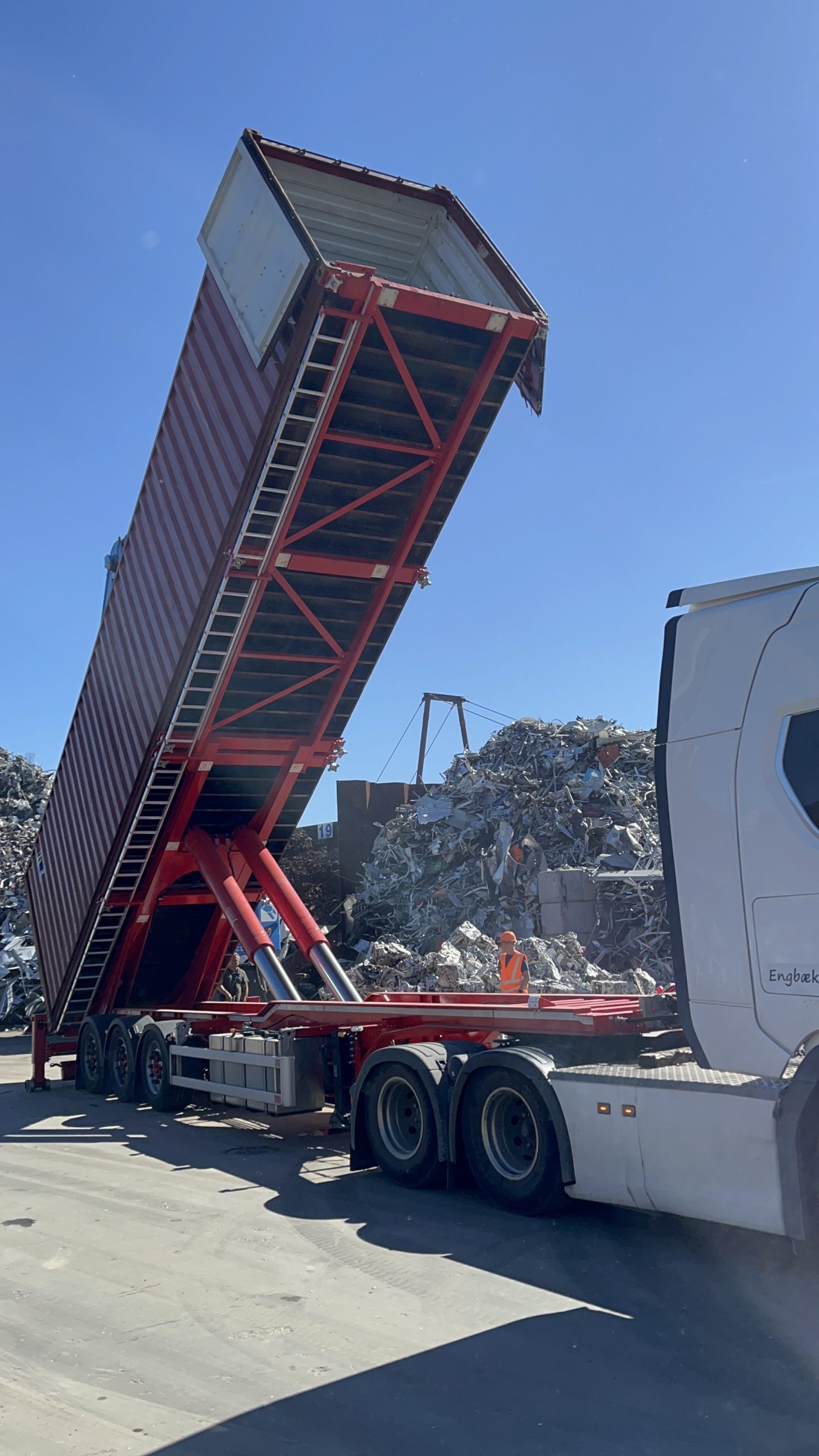
The 40ft Vertical Loader for Aluminium Scrap Container Loading design, featuring a reinforced chassis and hydraulic lift mechanism stands the container upright, allowing material to fill evenly from the top. This method eliminates sidewall impacts that damage containers, maximizes payload by achieving near 100% volume utilization, and drastically reduces loading cycle times for the crane operator.
Documented results from comparable operations indicate potential loading time reductions up to 30%, alongside substantial improvements in crane operator safety and container integrity. This report details the technical specifications, implementation challenges, measurable outcomes, and strategic context of VAKO’s solution, substantiating its role as a transformative asset in modern scrap yard logistics.
Product Overview
The development of the MVL40 Mobile Vertical Loader for Aluminium Scrap Container Loader is a direct result of VAKO’s engagement with the scrap metal recycling industry. Recognizing the unique demands of loading jagged, dense, and abrasive materials, VAKO Transport Systems B.V. applied its core competencies in heavy-duty chassis design and precision hydraulic control. This project builds upon the proven success of its smaller MVL20 model, scaling the technology to meet the high-throughput requirements of major scrap export operations. VAKO’s integrated approach combines container handling mechanics with operational workflow design, ensuring solutions like the MVL40 delivers not just a machine, but a complete process improvement.
Problem Statement
Inefficiencies of Traditional Loading Methods
Scrap metal export profitability is intensely sensitive to shipping efficiency, measured in cost per ton. Traditional methods for loading 40ft containers, such as using wheel loaders, excavators, or conveyor belts to push material horizontally into the container, are fraught with inefficiencies. These methods rely on the material’s angle of repose, often leaving significant “dead space” or air pockets within the container. Consequently, the container becomes physically full long before reaching its maximum weight capacity, leading to suboptimal payloads and higher freight costs per ton of shipped material.
Furthermore, horizontal loading subjects container sidewalls to constant scraping and impact from jagged scrap metal. This causes significant damage, including wall punctures and door frame deformation, necessitating frequent and costly repairs. The process is also notoriously slow, creating bottlenecks in the exportchain, especially during peak demand periods when rapid container turnaround is critical.
The manual and machinery-intensive nature of traditional loading poses substantial safety hazards.
Operators in wheel loaders or excavators work in close proximity to falling material and unstable piles, risking injury. The process often requires workers to be on foot to direct loading or manage spillage, exposing them to moving equipment and potential crush hazards. The repetitive, labor-intensive work also contributes to operator fatigue, which can further increase the risk of accidents.
From an operational standpoint, these methods are dependent on multiple pieces of equipment and personnel, complicating coordination and increasing fuel and maintenance costs.
Solution Overview
The 40ft Vertical Loader for Aluminium Scrap Container Loading Concept
VAKO’s solution is the 40ft Vertical Loader: a long lasting hydraulic pressure via the connection of the truck. The unit is specifically engineered for loading bulk scrap into ISO containers. The core innovation is its vertical loading methodology.
Scrap material is transported into the container and descends vertically under gravity directly into the container box.
This gravity-assisted discharge ensures the material settles densely from the bottomup, naturally compacting and eliminating air pockets. The vertical drop path prevents any lateral force or scraping against the container’s sidewalls, thereby eliminating the primary cause of container damage. The system is designed as a continuous loading process, significantly increasing throughput compared to batch-style horizontal methods.
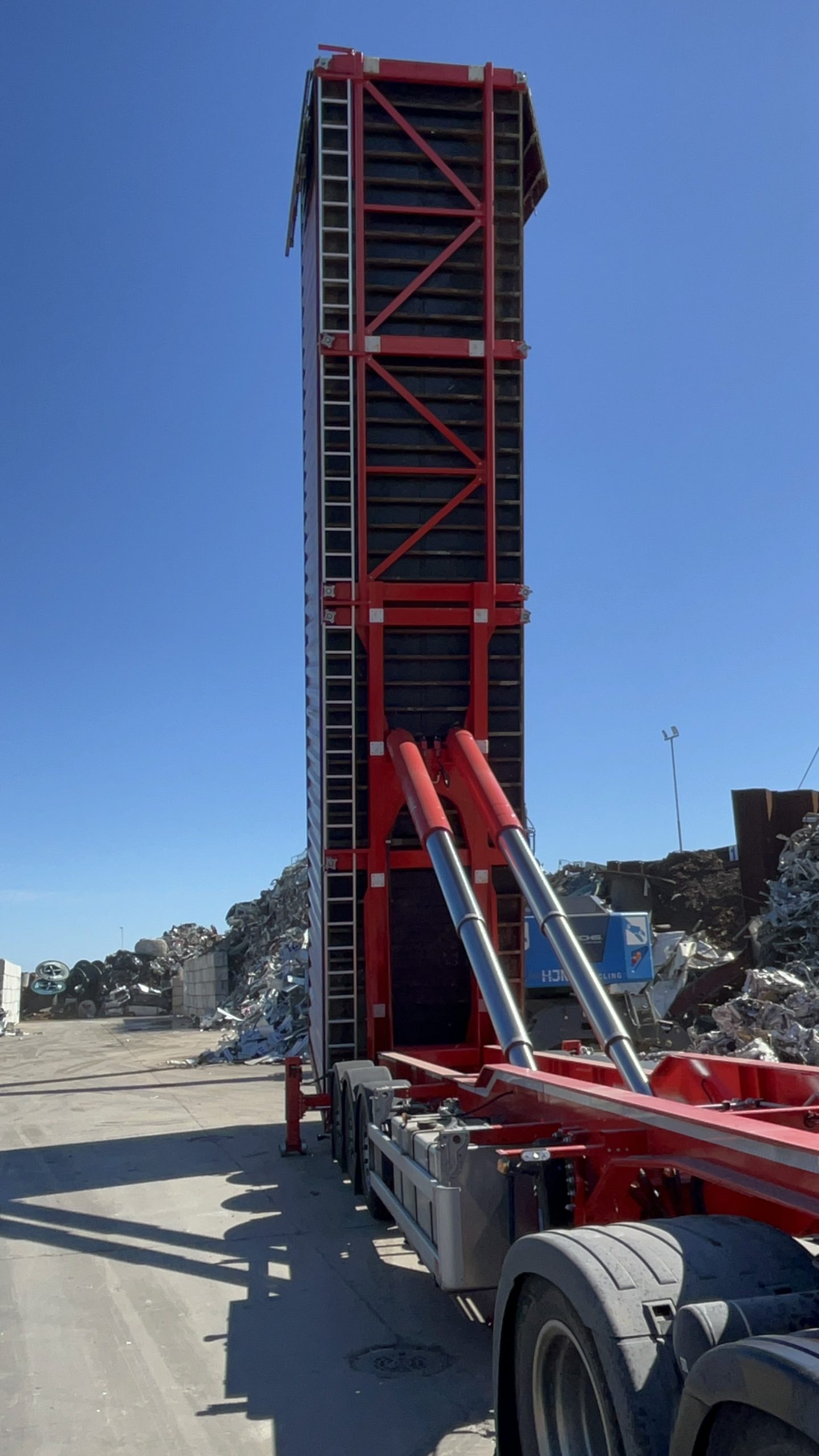
Key Technical Specifications and Design
Engineered for continuous loading of heavy scrap, building upon the validated design principles of VAKO’s smaller MVL20 model to handle the larger volume of a 40-foot container.
The discharge chute is elevated by two synchronized, robust hydraulic cylinders, providing smooth and precise positioning to accommodate standard 40-foot container heights and ensure optimal drop height for various material types.
The chassis and critical load-bearing components are fabricated from high-tensile steel to withstand the stresses of handling jagged, abrasive ferrous scrap. Extendable rear stabilizer legs deploy to create a wide, stable footprint during the lifting and loading operation.
Mounted on heavy-duty axles and wheels, the 40ft is fully mobile within the yard and public roads.
Operation is conducted via a wireless remote control, allowing the operator to manage the entire process from a safe distance. Safety interlocks, and compliant control systems are integrated to minimize exposure to hazards.
Implementation
Site Integration and Deployment
The implementation of the 40ft is characterized by its “plug-and-play” mobility. Unlike fixed installations, the mobile unit requires minimal on-site preparation. Primary requirements include a firm, level surface for the container placement and adequate overhead clearance for the raised container chute. The process typically involves positioning the empty container, on the chassis, maneuvering the trailer into place adjacent to it, deploying the stabilizer legs, and commencing the loading cycle.
Integration with existing material feed systems – such as conveyor belts, grapples, or loaders – is straight forward. The unit’s hopper is designed to receive material from these standard yard equipment, creating a seamless link between material processing and container loading stations. This flexibility allows yards to incorporate the MVL40 into their current layout without major infrastructural changes, which adds a simultaneous win within the deployment area.
Engineering Challenges
Designing a mobile unit capable of handling the dynamic loads of scrap metal presented significant engineering challenges. VAKO addressed these through advanced design and material selection:
- Container Structural Durability: The need to withstand impact from jagged scrap were met. VAKO Transport Systems B.V. succesfully installs it’s products to optimize stress distribution within containers and prevent fatigue failure.
- MVL40 Hydraulic Control: Achieving a smooth, jerk-free lift of the container chute was critical for stability and precision. This was accomplished through precise hydraulic calibration, valve selection, and cylinder synchronization, ensuring controlled movement even under full load.
- Center of Gravity Management: Lifting a heavy container to a significant height alters the machine’s center of gravity. The design of the extendable rear legs and the chassis weight distribution was meticulously calculated to maintain stability throughout the entire range of motion, preventing any risk of tipping.
Key Metrics & Outcomes
The implementation of the 40ft system yields measurable gains across several key performance indicators (KPls) critical to scrap export operations.
Quantitative Performance Improvements
Loading Cycle Time
Container Volume Utilization
Payload per Container
Labor Requirement
Container Damage Incidence
These metrics are supported by industry benchmarks. For instance, competitor’s tilt-based systems report loading times under 5 minutes, while one of our main competitor’s stationary systems cite 10-minute cycles for HMS scrap. VAKO’s documented case studies show a significant 15 to 35% faster loading speed, with the potential up to 45% improvements in optimized scrap operations, aligning with these competitive benchmarks.
Qualitative and Strategic Benefits
Beyond the numbers, the 40ft delivers profound qualitative benefits:
- Enhanced Safety: Remote operation removes personnel from the immediate loading zone, drastically reducing exposure to falling material, equipment collisions, and other yard hazards. The remote controlled process minimizes risky manual interventions.
- Container Longevity: The complete elimination of sidewall scraping preserves the structural integrity of costly shipping containers. This translates directly into reduced maintenance budgets, fewer rejected containers at port, and extended asset life.
- Operational Flexibility: The unit’s mobility allows a single vertical loader to service multiple loading points, adapt to changing yard layouts, and handle peak demands without the need for fixed infrastructure investment.
- Environmental Impact: Maximizing the payload per container reduces the number of containers required to ship a given tonnage of scrap. This decreases the total fuel consumption and associated carbonemissions of the maritime transport leg of the supply chain.
Strategic Implications and Market Context
The VAKO 40ft Mobile Vertical Loader represents a definitive solution for scrap processors seeking to optimize their export logistics. In a competitive global market where freight costs are volatile and profit margins are tight, the ability to maximize units safely is a critical competitive advantage. By ensuring each container is loaded to its maximum weight and volume potential, the MVL40 directly de-risks operations against rising shipping rates.
The solution exists within a competitive landscape that includes container tilting systems and stationary vertical loaders. VAKO’s key differentiation lies in its fully mobile, standalone vertical design, which offers unparalleled flexibility without the need for permanent foundations or trailer-based systems. This makes it particularly suitable for yards with space constraints or evolving operational needs.
Conclusion
Data from manufacturer specifications and aligned industry case studies confirm the core value propositions of the MVL40: dramatic gains in loading speed, payload, safety, and efficiency. While much performance data originates from promotional sources, the consistency of reported benefits across the industry and the logical engineering principles underpinning the vertical loading method lend strong credibility to the claims.
Final Assessment and Recommendations
For scrap facilities evaluating this technology, the recommendation is to conduct a site-specific analysis of material flow and container turnover. The highest return on investment will be realized in high-volume export operations where container damage costs are significant and loading bottlenecks exist. For future scaling, facilities should consider pairing the MVL40 with automated feed systems to create a fully streamlined, hands-off loading environment, further driving down operational costs and enhancing safety. The MVL40 from VAKO Transport Systems B.V. stands as a validated, engineered response to the enduring challenges of scrap container loading, transforming a chaotic, costly process into one of precision, efficiency, and reliability.
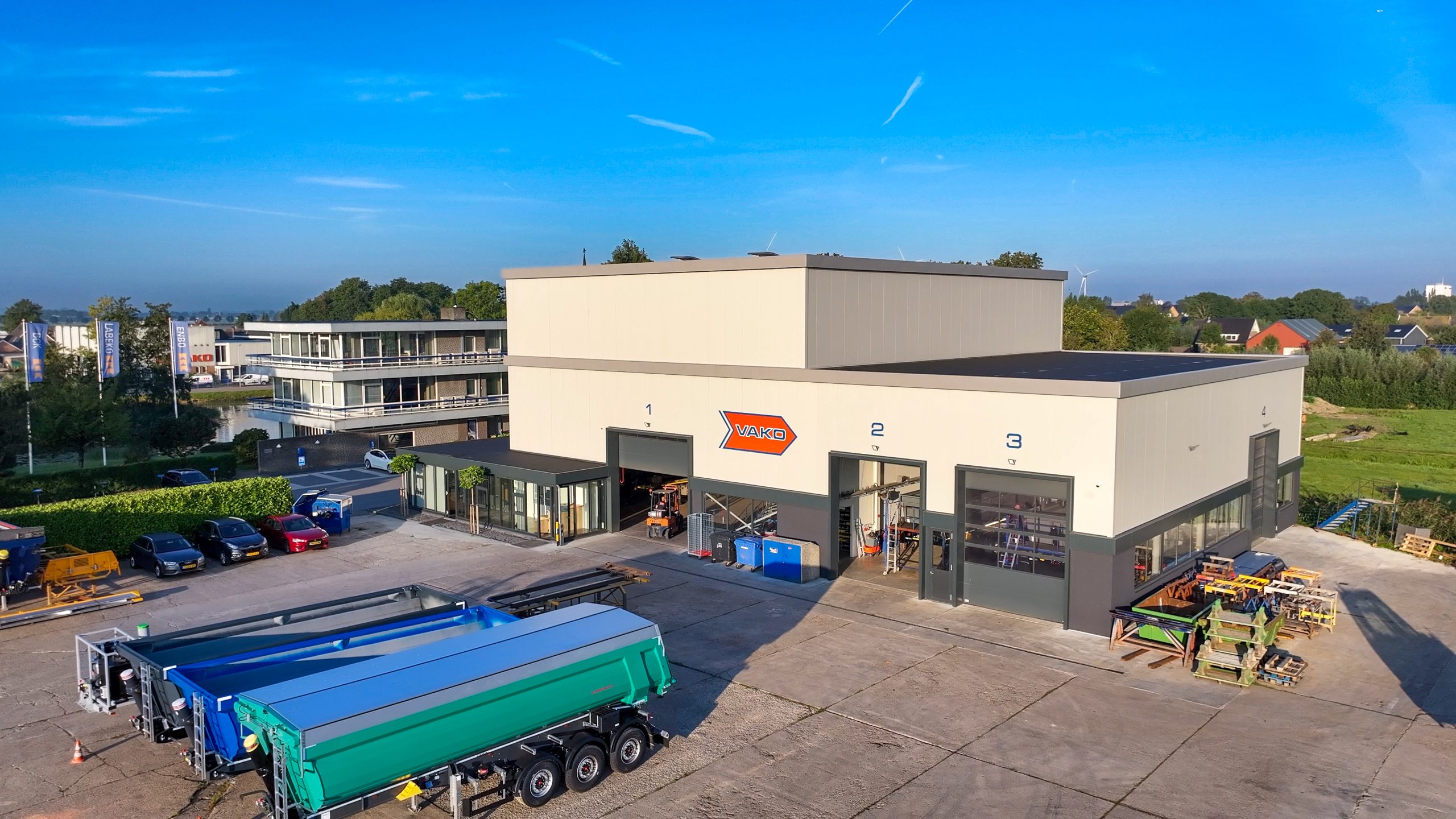
Feel free to talk with us, whether it’s our sales department or one of our engineers.
See how much payload you’re currently leaving on the table
Most scrap operations underestimate their efficiency loss by 20–30%. Request a quick analysis based on your operation.
- Estimated payload increase for your material type
- Loading cycle time benchmark vs your current method
- Indicative ROI for switching to vertical loading
Loading…
Our engineering team reviews each request manually to provide a relevant technical response based on your loading setup and operational requirements.
Typical response time during business days: within 24 hours.
Prefer direct contact? Call us at +31 (0) 71 – 341 07 05
Our opening hours: Monday to Friday, 08:00 – 17:30 office hours.