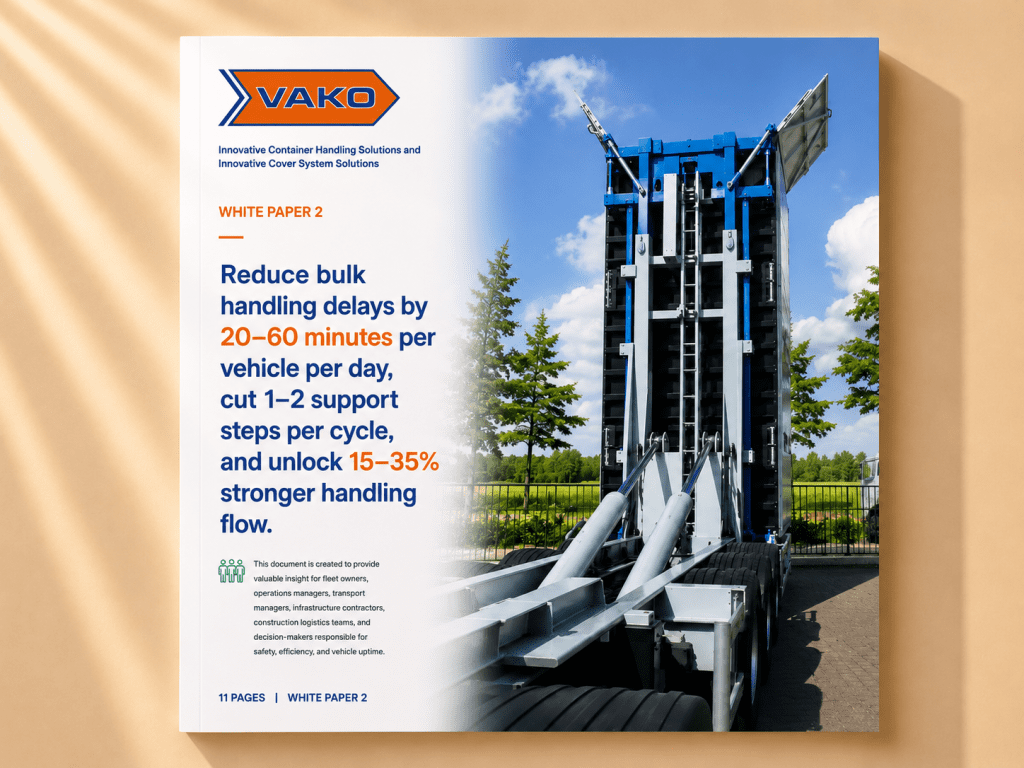
Whitepaper 2 · VAKO Transport Systems B.V. · Bulk Handling, Site Logistics & Industrial Transport
Reduce bulk handling delays by 20–60 minutes per vehicle per day, cut 1–2 support steps per cycle, and unlock 15–35% stronger handling flow.
This whitepaper explains where bulk transport performance is quietly won or lost across recycling, scrap metal, logistics, supply chain, maritime flows, and industrial site operations. When loading, unloading, transfer, tipping, and container handling are not engineered as part of the workflow, delays, labor dependency, support-equipment conflict, and safety exposure compound every day.
Bulk transport losses rarely appear as one major failure. They are embedded in routine: waiting for loading, repositioning, secondary handling, manual corrections, and avoidable support-equipment dependency.
potential cycle-flow improvement
daily waiting-time reduction potential
support steps per handling cycle
What you’ll discover
A practical breakdown of where engineered bulk handling creates value in daily site logistics and industrial transport.
Why waiting, repositioning, and manual corrections reduce usable transport value.
How labor-heavy, equipment-dependent workflows become fragile as throughput pressure rises.
How vertical loading, tipping, unloading, and custom hydraulic handling reduce friction between material movement and material control.
Relevant VAKO sectors
Where bulk transport determines performance
In modern bulk handling and transport, the challenge is no longer only how to move material from one place to another. The real challenge lies in how efficiently that material can be loaded, handled, transferred, discharged, and controlled under real working conditions.
What changes after engineered bulk handling?
Waiting and repositioning
Support-equipment dependency
Loading, discharge, and transfer flow
Safety and operational control
Continue with the full whitepaper
Below, you’ll find the full analysis: where bulk transport determines performance, how pressure has intensified, where value is lost without visibility, why traditional handling no longer matches demand, how VAKO thinks differently, what better bulk handling looks like in practice, where gains start to matter, market movement, compliance and future readiness, and why leading bulk transport operators choose VAKO.
Full Whitepaper
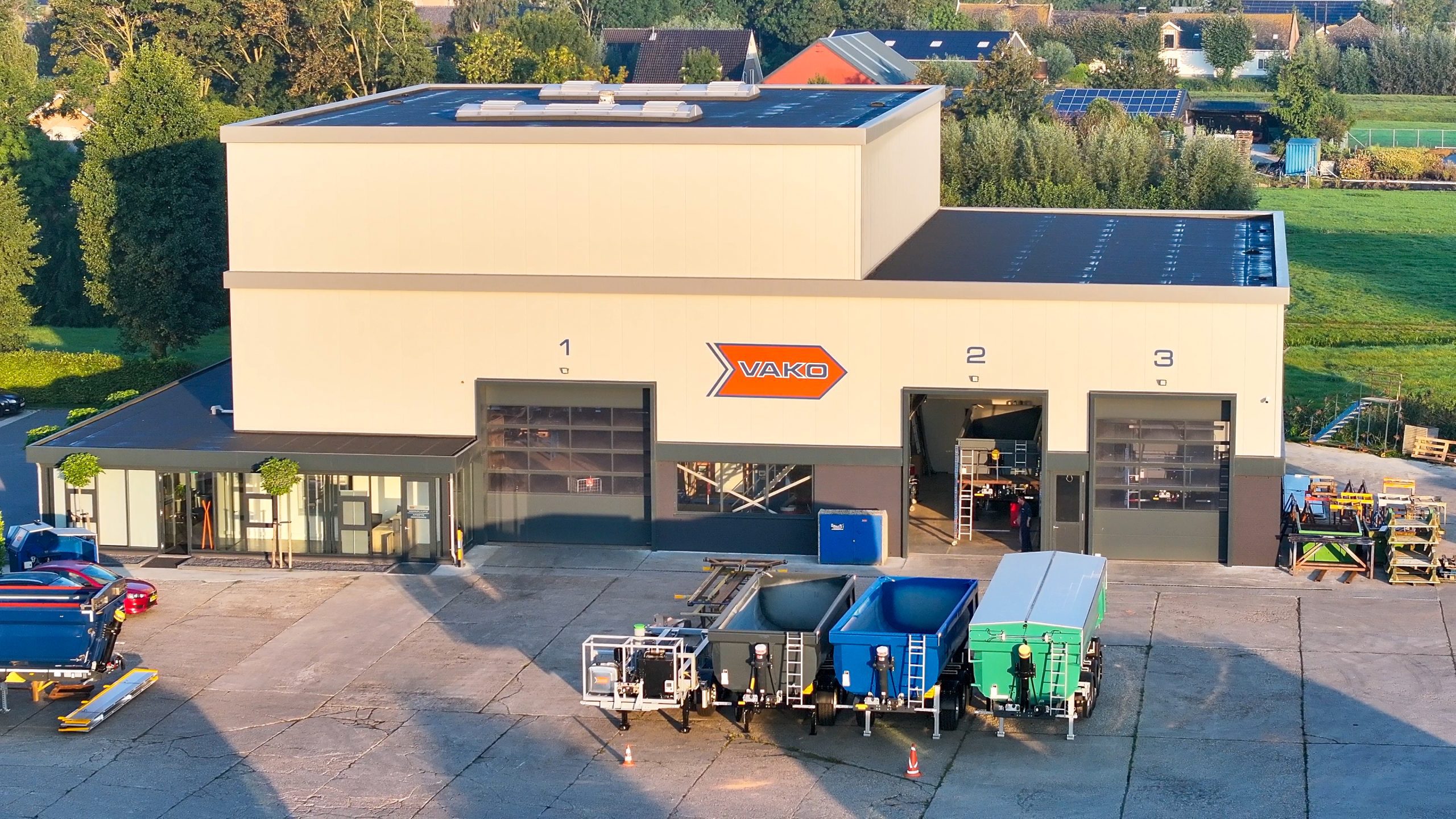
VAKO Transport Systems B.V. has established itself as a pioneer in European and international markets by addressing complex logistical challenges in bulk handling, site logistics, recycling and scrap metal operations, logistics and supply chain environments, maritime flows, and industrial transport.
Bulk transport is rarely what companies talk about when they discuss operational performance. Most time tends to go to fleet capacity, project execution, delivery deadlines, terminal planning, production continuity, or site output. Yet the performance of bulk transport often decides whether those larger ambitions can actually be achieved.
Materials such as aggregates, sand, powders, demolition fractions, minerals, scrap-related materials, dry bulk inputs, containerized materials, and industrial bulk goods move continuously between terminals, depots, contractors, transfer points, transport hubs, maritime locations, recycling yards, scrap processing sites, and industrial environments.
These movements are not merely logistical. They are operational pressure points. Every delay in loading, every inefficient discharge, every unnecessary handling step, and every avoidable dependency on support equipment has a direct effect on time, labor, safety, and profitability.
That is why bulk transport deserves to be viewed differently.
This document examines where VAKO’s container handling systems become solutions which align with the operational demands of bulk handling, recycling, scrap metal, logistics, supply chain, maritime, and industrial site operations. Additionally, it explains how these solutions can support a safer, more controlled, and more efficient transport process in daily use.
Prepared for European and international decision-makers in bulk handling, site logistics, recycling, scrap metal, logistics, supply chain, maritime, and industrial transport.
Where Bulk Transport Determines Performance
In modern bulk handling and transport, the challenge is no longer only how to move material from one place to another. The real challenge lies in how efficiently that material can be loaded, handled, transferred, discharged and controlled under real working conditions. That is where a great deal of operational value is either created or quietly lost.
For many companies in these sectors, those losses are not dramatic enough to trigger immediate alarm. They appear in smaller, recurring forms. A truck waits longer than expected before it can be loaded. A discharge point causes avoidable downtime because it needs too much manual supervision. A trailer or container is not used to its full practical capacity because the handling method itself limits what is possible. Operators spend time managing a process that should already have been engineered to run more predictably.
Over time, these moments begin to define the economics of the operation.
This is where VAKO Transport Systems B.V. enters the picture with strong relevance. As an established Dutch engineering company specializing in container handling systems, loading and unloading systems, tipping systems, hydraulic transport applications, and custom-built industrial handling solutions, VAKO addresses the part of bulk transport that many businesses still underestimate: the handling process between arrival and departure.
That distinction matters because in bulk transport, commercial performance is often won or lost before the vehicle even reaches the road.
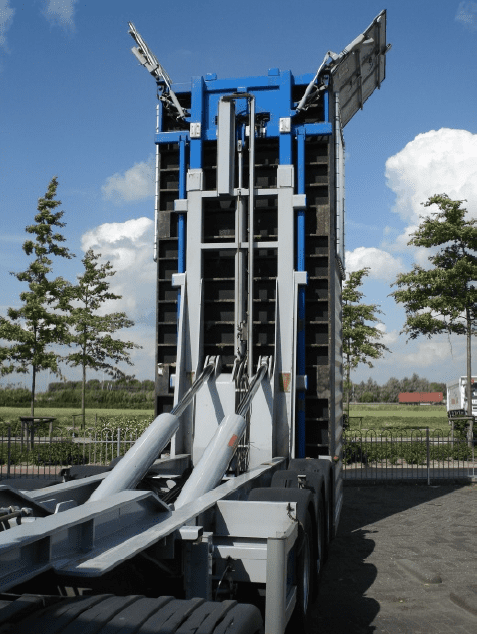
VAKO’s relevance to these sectors lies in its ability to turn operational friction into engineered flow. Vertical Loading is the answer. That means fewer unnecessary movements, more controlled handling, stronger use of available capacity, safer workflows, and better daily throughput. It is not about making the process look more advanced. It is about making it work better in ways that are commercially meaningful.
For companies operating in Recycling & Scrap Metal and Logistics & Supply Chain / Maritime, that is exactly the kind of improvement that creates long-term value.
When you see our products in action, you’ll know.
The Pressure on Bulk Transport Has Intensified
The environment in which bulk transport operates has become more demanding. What used to be absorbed through flexibility or extra labor now shows up as cost, delay, or operational risk.
Companies are experiencing growth and are being pushed from multiple directions. Planning is tighter, labor availability is more limited, and expectations around safety and efficiency continue to rise. At the same time, operations are expected to remain flexible and responsive.
This combination exposes weaknesses in existing workflows.
Loading and unloading are still often treated as secondary steps rather than performance-critical operations. As a result, inefficiencies remain embedded in daily routines. Site managers and operational teams may have accepted these routines because they appear to require minimal workflow intervention. Yet vehicles arrive but cannot be processed immediately. Material transfer depends on coordination rather than structural system design. Equipment availability shapes the process instead of the process shaping equipment use.
Even strong transport capacity cannot compensate for weak handling performance.
That is why companies are increasingly shifting focus toward handling efficiency. They recognize that margin is influenced not only by transport volume, but by how quickly, safely, and predictably each cycle is executed.
This shift is visible across the wider market, where engineered loading and unloading solutions are increasingly positioned as drivers of throughput, safety, and labor efficiency. It reflects a broader reality: processes must go on, even when throughput is stuck and conditioned by its own design, not just function.
This is exactly where VAKO Transport Systems B.V. contributes to optimization. Looking at a company’s situation from a distant angle allows us to manage and create customized technical products which are future proof and make impact.
Where Value Is Lost Without Visibility
In bulk transport, losses rarely appear as obvious failures. They are embedded in routine.
Vehicles are present but not productive, waiting for loading, discharge or positioning. This idle time consumes capacity without generating value. Handling continuity is another issue. Processes often involve unnecessary steps such as repositioning, secondary handling, or manual corrections. Each step adds time and reduces flow efficiency.
Capacity is also underutilized. Containers and trailers are not always filled or handled optimally, reducing usable transport value and requiring more cycles to achieve the same output. Support-equipment dependency adds further pressure. When processes rely on multiple machines and operators, they become fragile. If one element is delayed, the entire workflow slows down.
A slow loading cycle creates delays. Delays increase pressure. Pressure leads to improvisation. Improvisation reduces consistency and increases risk. Over time, this becomes structural.
This is where VAKO Transport Systems B.V. contributes sustainable value — by engineering control into the points where performance is decreased.
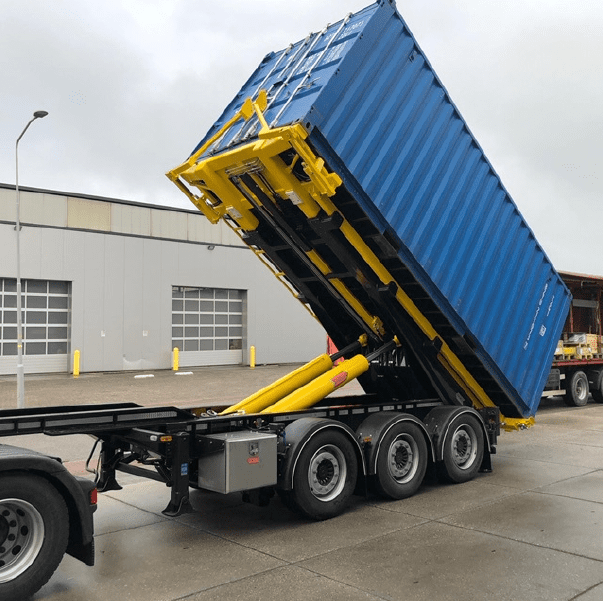
Why Traditional Handling No Longer Matches Demand
Traditional bulk handling methods often survive because they are familiar. They are known by the team, already integrated into daily routines, and capable of “getting the job done.” But the fact that something still works does not mean it is still economically or operationally competitive. That distinction is becoming increasingly important.
In many recycling, scrap metal, logistics, maritime, supply chain, and industrial bulk environments, transport is still supported by a mix of wheel loaders, excavators, forklifts, manual intervention, and ad hoc positioning. Materials are pushed, tipped, repositioned, opened, transferred, and discharged through methods that evolved gradually rather than through deliberate process engineering.
These methods often emerged because they were practical at the time. But as operational expectations have changed, their limitations have become more costly.
One of the clearest limitations is that traditional handling methods are rarely designed for repeatable speed. They can often complete the task, but not with the level of consistency that modern operations increasingly require. Cycle times vary too much. Throughput becomes dependent on who is present, what equipment is available, and how much improvisation is needed at the moment.
That variability is commercially damaging because it makes planning weaker. If the handling process is unpredictable, the wider operation becomes less predictable too.
Traditional methods also remain too dependent on human coordination. That does not only mean labor cost. It means the process itself requires more supervision, more judgment calls, more physical presence, and more intervention than it should. In environments where operators are already stretched, that becomes a structural weakness.
There is also a safety dimension that cannot be ignored. Workplace loading and unloading continue to be recognized as high-risk activities, especially where vehicles, mobile equipment, reversing movements, falling materials, and pedestrian interaction overlap. Safety authorities continue to identify these moments as recurring causes of serious incidents.
This matters commercially because risk exposure is not only about compliance. It also affects:
- process stability,
- site discipline,
- insurance sensitivity,
- workforce confidence,
- and customer trust.
Traditional methods also tend to scale poorly. A process that is “good enough” at lower volume becomes much less acceptable when throughput increases or when planning windows become tighter. What was once tolerable inefficiency turns into visible operational drag.
This is why more companies are moving away from workaround-based bulk handling and toward engineered process control.
How VAKO Thinks Differently About the Process
What makes VAKO Transport Systems B.V. particularly relevant to bulk transport is that we do not begin with the equipment. We begin with the relevant workflows of the company. That is a major difference.
Many suppliers in adjacent markets focus primarily on machinery specifications, capacity statements, or isolated technical features. VAKO’s strength lies elsewhere. We focus on how the system fits into the real operating sequence: where the bottleneck occurs, where time is being lost, where the handling step becomes unnecessarily labor-heavy, where support equipment is overused, and where the process itself can be made more direct.
That way of thinking is highly valuable, because these are not static environments. Material flows vary, layouts change, transfer points evolve, and operational constraints shift over time. A useful solution in this sector is not simply one that performs well under ideal conditions. It is one that continues to create value under practical conditions.
VAKO’s engineering approach is built around that reality.
Through our work in container handling, loading and unloading systems, tipping applications, vertical loading concepts, hydraulic transport engineering, and bulk-related custom systems, VAKO consistently addresses the same commercial objective: improving the way industrial material handling performs in practice. That can mean different things depending on the application.
In one environment, the primary value may lie in reducing loading time. In another, it may be about lowering labor dependency. In a third, the real value may be safer discharge behavior, improved site flexibility, or stronger use of available transport capacity. The point is not that every customer has the same problem. The point is that many customers suffer from the same type of inefficiency: too much friction between material movement and material control. VAKO’s systems help reduce that friction.
The commercial strength of this approach is that it creates improvements that are visible on the ground. When a process becomes more controlled, the impact is felt immediately. There is less hesitation in the workflow. Less waiting. Less uncertainty around how the next step will be completed. Less dependency on “how it is normally done.” More confidence that the process will perform consistently, even when site conditions are demanding. That is where engineering becomes commercially powerful.
For bulk transport operators, the benefit is not simply that the equipment looks more advanced. The benefit is that the operation begins to move with greater logic. That is the difference between handling as a necessary burden and handling as a competitive advantage.
And that is where we explore the market.
What Better Bulk Handling Looks Like in Practice
The value of engineered handling becomes much easier to understand when viewed through real operational use.
In bulk transport within recycling, scrap metal, logistics, maritime, supply chain, and industrial site operations, the same pressure points appear across a range of applications. Materials need to move from terminal to site, from storage to transfer point, from processing area to outbound transport, or from container to receiving system. Each of those moments involves the same underlying question: how efficiently can the material be handled without introducing unnecessary delay, risk or labor dependency?
Practical relevance becomes highly visible.
In terminal-linked environments, the priority is often turnaround. Vehicles cannot afford to remain static for too long because delays immediately affect throughput and scheduling. Here, a more engineered handling approach can reduce the number of steps required between arrival and departure, creating a more direct and commercially efficient cycle.
In temporary or semi-permanent site environments, the challenge is usually flexibility. Fixed infrastructure is possible, but often not realistic. Yet the process still needs to be safe, reliable, and efficient. VAKO’s experience with mobile and application-specific hydraulic handling is particularly valuable in these conditions because it allows performance to be created without demanding ideal infrastructure.
For example, vertical loading requires less space, which increases on-site flexibility without an increase of m².
In contractor logistics hubs, recycling yards, maritime transfer locations, and bulk transport hubs, the commercial pressure is often centered on internal flow. Materials may be moving in high frequency, but the process around them remains too fragmented. Too many supported operator steps, too much equipment conflict, and too much dependency on timing between operators can weaken the rhythm of the operation. Here, a better-engineered process can simplify movement and improve the rhythm of the operation itself.
In cross-border or structured container flows, the focus shifts more toward control, consistency, and usable transport value. When containers or transport units are part of repeated international or multi-stage logistics chains, every inefficiency compounds over time. Better loading geometry, stronger handling predictability, and more efficient use of available space all become strategically relevant.
VAKO also has clear relevance where bulk transport and load containment intersect. Cover systems, secure handling arrangements, and practical loading readiness are often treated as secondary concerns, but they influence both compliance and daily usability. In demanding bulk environments, a process that is not secure, not clean, or not easy to prepare quickly will almost always create downstream inefficiency.
This is why VAKO’s value in these sectors is not reduced to a single product category. Our strength lies in the broader handling logic it brings to bulk transport operations. It contributes to a more efficient chain by improving the moments where material is physically managed.
And those moments are often where the greatest practical gains are available.
Where the Gains Start to Matter
Buyers in this sector do not invest in engineered handling because it sounds good. They invest because the gains begin to justify the decision. We have adapted ourselves during several decades and have achieved strong results, which led to repeated purchases.
True value of better bulk handling should always be viewed in terms of process first. Once the process improves, the commercial outcome usually follows.
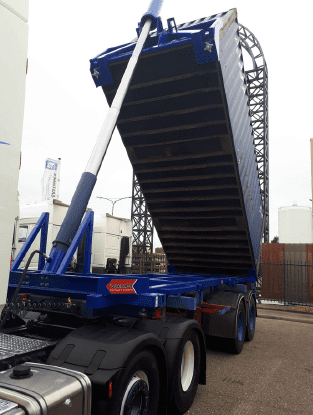
When bulk handling becomes more controlled, the first visible gain is usually time. Loading or unloading cycles become shorter, or at least more predictable. That alone creates value because time lost in handling is time that cannot be used elsewhere in the operation. Faster cycle completion means more throughput capacity, better vehicle use and stronger scheduling confidence.
The second visible gain is usually labor efficiency. When the process requires fewer support steps and less physical supervision, the same operation can often be completed with fewer people involved or with the same team achieving more across the day. In a market where labor remains under pressure, that is not a small advantage.
The third visible gain is often reduced process friction. Less waiting. Less repositioning. Less support-equipment conflict. Less dependency on improvisation. These gains are not always visible as a single line item in a cost model, but they have strong operational and financial consequences over time.
A Market That Is Moving
The wider market around loading, unloading and container-related handling is experiencing growth. Across adjacent sectors, there is growing investment in automated loading, loading systems, vertical container handling, tipping systems, and integrated transfer solutions.
That movement is important because it confirms something the market has already recognized: traditional handling is increasingly too slow, too labor-heavy and too operationally fragile for modern industrial expectations.
But it also creates a second challenge for buyers. The challenge is not only choosing whether to modernize. It is choosing how.
Some suppliers are strongest in highly standardized automation. Others focus on fixed infrastructure or very specific handling scenarios. Some are strong in warehouse-linked logistics but less relevant in rugged industrial bulk environments. Others can fabricate, but not necessarily with the level of repeatability, system maturity, or export-ready professionalism that serious industrial buyers increasingly expect.
This is where VAKO Transport Systems B.V. occupies a particularly useful position.
VAKO sits in a commercially strong space between standardized industrial handling logic and practical complex custom engineering. That combination matters greatly in bulk transport, because this is a sector where operational environments vary widely. We have trained ourselves to be future proof. A solution that works in one location often needs to be adapted to function properly in another. Buyers need more than a concept. They need a system that fits the actual workflow, the actual material, the actual site constraints, and the actual business objective.
Long-term success has never felt this way for us, but also for our buyers. For our buyers this means the conversation can move beyond generic machinery claims and toward something much more valuable: a practical engineering dialogue about how to improve. That is a far stronger place to start a business relationship.
Why Compliance and Future Readiness Now Matter Commercially
For many years, safety and compliance were often treated as parallel concerns in industrial handling. Important, yes — but separate from the commercial discussion. That is no longer realistic.
In today’s environment, compliance, operational discipline, and long-term process control are increasingly intertwined. Buyers are under more pressure to demonstrate that their handling processes are not only productive, but also safe, controlled and fit for long-term use in demanding industrial environments. That shift is visible around the world.
In Europe, the EU Machinery Regulation (EU) 2023/1230 raises expectations around machine safety, intended use, risk reduction, and manufacturer responsibility, reinforcing the need for handling systems that are properly engineered and professionally integrated. Workplace safety guidance also continues to highlight loading, unloading, reversing, falling loads, and vehicle interaction as major operational risk areas, especially in industrial and transport-linked environments.
For companies in bulk transport, this has a very practical implication. It means that loosely controlled, overly manual, or improvised workflows are becoming harder to justify — not only from a safety perspective, but from a commercial one. The more risk, variability, and uncertainty a process contains, the more vulnerable the operation becomes over time.
That is why better handling systems create value beyond immediate throughput.
They help companies move toward:
- stronger process discipline,
- safer site behavior,
- more predictable operating conditions,
- and more future-proof asset use.
In recycling, scrap metal, logistics, maritime, supply chain, and industrial bulk handling, this matters especially because many environments are temporary, mobile or operationally dynamic. Solutions must not only perform well in stable factory conditions. They must remain useful under changing site realities.
This is another reason why VAKO Transport Systems B.V. is a strategically relevant partner. VAKO contributes not only to daily operational improvement, but also to the longer-term integrity of the process itself. That strengthens the business case far beyond short-term handling gains. And increasingly, that is exactly what buyers want.
Why Leading Bulk Transport Operators Choose VAKO
VAKO Transport Systems B.V. operates where engineering and operational reality meet. Our strength lies in improving how bulk handling performs under real conditions — with real materials, real constraints, and real pressure.
This creates value in:
- throughput,
- efficiency,
- safety,
- and operational control.
As the demands on bulk transport efficiency continue to grow, the companies that perform best will be those that improve the process behind the movement. That is the space where VAKO Transport Systems delivers value, as seen in relevant industry sectors.
Every bulk transport operation contains opportunities for improvement. Many are hidden in routine, as companies accept delays on a day-to-day basis. We identify those moments and turn them into measurable performance gains.
Better handling does not only improve the process. It improves the business behind it. Better handling saves money, and time, and decreases onsite injuries and potentially saves lives.
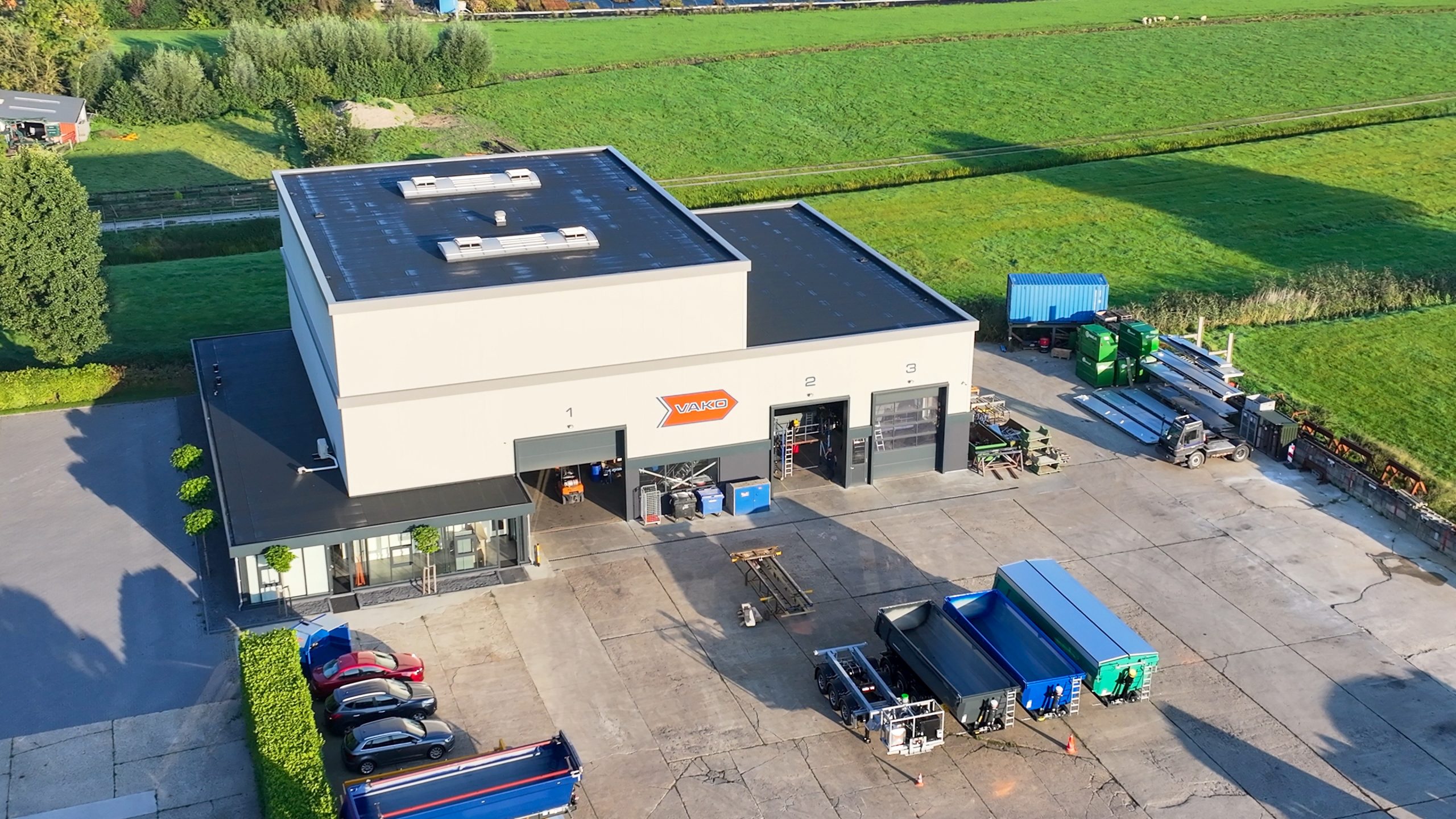
Feel free to talk with us directly via phone, whether it is our sales department or one of our engineers. You are more than welcome to fill in our form to schedule a call with us.
VAKO Transport Systems B.V.
Hondsdijk 3a
2396 HG Koudekerk aan den Rijn
The Netherlands
Phone number: 0031 (0) 71 – 341 07 05
Email: info@vakotransportsystems.nl
www.vakocontainerhandling.com
www.vakotransportsystems.nl
See where your bulk handling process is quietly losing time
Many bulk transport operations underestimate the financial impact of waiting time, repositioning, support-equipment conflict, manual supervision, and unpredictable loading or discharge routines. Request a quick analysis based on your operation.
- Estimated handling-flow improvement potential
- Indicative waiting-time and support-equipment reduction opportunities
- Application-fit recommendation for your material, container, site, or transport workflow
Our engineering team reviews each request manually — expect a response within 24 hours.
Prefer direct contact? Email us at info@vakotransportsystems.nl